


Share This Article
The group’s lawyers are using a rare tactic, called 7A—which the Mamdani administration has endorsed—to sideline negligent landlords and compel repairs. Transferring management is a drastic step, but tenants say there is no other option.
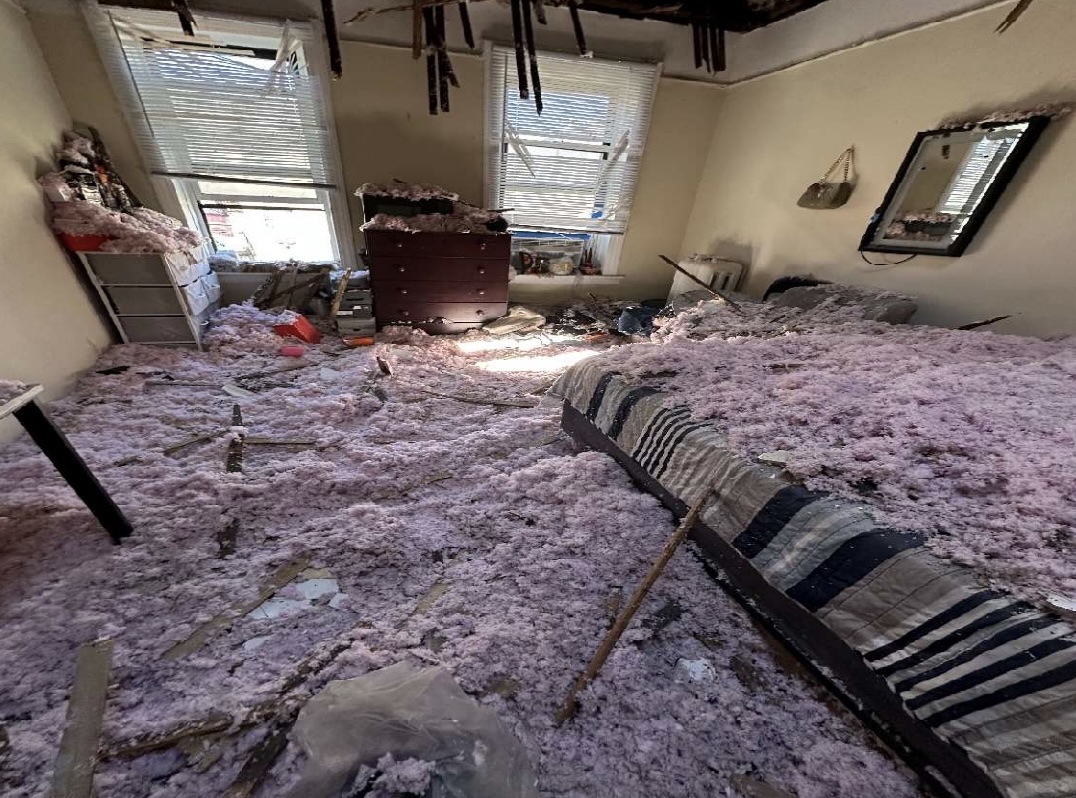
“This what happens when u rent to Pigs,” landlord Bradley Zar wrote in a text message about his tenants last year, according to court documents.
One of Zar’s tenants, Quasar García, has been living in a homeless shelter since October. The NYC Department of Buildings deemed his Fordham Heights basement apartment uninhabitable, following months of persistent water damage from the building’s faulty pipes that had rotted the joists under the floor and leaked soapy, used water onto his belongings.
Upon inspection, DOB also determined that the building’s other basement apartment had been converted illegally, and handed down another partial vacate order for that unit, where García’s mother—who is disabled—was living. She’s been staying in temporary housing since December.
García says that the landlords—Bradley and his brother Ryan Zar, operating under Point 2440 Realty LLC—changed the locks when he left. When he sued, the court ordered the brothers to correct the outstanding violations and fix up the apartment, the deadline for which was earlier in July. The partial vacate order is still in place.
“I feel powerless, dehumanized, in a place where I don’t feel safe. I’m in a state of constant tension,” García, between sobs, told City Limits in Spanish. “They’ve stripped me of my freedom, my privacy, and my peace.”
Now, García and other tenants at 2440 Walton Ave. in the Bronx are filing a lawsuit against Point 2440 Realty LLC, seeking to transfer the building’s management to a court-appointed administrator to address what they describe as years of systemic neglect and harassment.
The petition, filed on June 3, seeks to make the change under Article 7A of New York’s property laws, which allows the court to put an administrator in charge if a building’s owner fails to address dangerous conditions. The Walton Avenue lawsuit cites the landlords’ denial of responsibility to make repairs, and says repeated episodes of intimidation constitute harassment.

“The larger takeaway is that there’s a pervasive and ever-present contempt for their tenants and their safety and well-being,” said James Tourangeau, senior coordinating attorney at New York Legal Assistance Group (NYLAG), who represents the tenants. “This building fits into this broader pattern of irresponsibility and incompetence and intentional neglect.”
Neither Bradley Zar nor the brothers’ lawyer in the case replied to requests for comment.
According to Tourangeau, there are only about two dozen active 7A administratorships in the city, making it a relatively little-invoked proceeding. Even so, Mayor Zohran Mamdani pledged to “aggressively use the 7A program” in his Fix the City initiative, a series of proposals to ramp up enforcement against bad landlords as part of his broader Block by Block housing plan.
The goal? To move those buildings “out of these bad actors’ hands and conveyed to responsible preservation purchasers who are supported by both tenants and the administration,” the mayor’s plan reads.
Although 7A does not transfer ownership, it is one of many mechanisms that could indirectly lead to this outcome. While a building is under 7A administratorship and landlords are not getting rent payments, the city could encourage the owner to sell to a preservation buyer, including by placing additional financial pressure on them through civil penalties or, in some cases, engaging with lenders to initiate foreclosure proceedings.
The insinuation that the city might be removing properties from certain landlords’ hands and transferring them to handpicked buyers has, naturally, rankled many building owners. Still, the Zar brothers represent the type of landlord that the Department of Housing Preservation and Development (HPD) seeks to go after to compel repairs and better living conditions for tenants.
“Every tenant has the right to safe, well-maintained housing,” said HPD Commissioner Dina Levy in an emailed statement. “HPD will continue to support the tenants at 2440 Walton Avenue as they seek the appointment of a 7A administrator, one of the most significant tools available to ensure that rents are used for maintaining a property and resources are available to support systemic repairs.”
HPD has also pursued independent legal action against the Zar brothers for false certifications of dozens of HPD and DOB violations, which landed them on HPD’s certification watchlist in January. The case is still ongoing.
Years of alleged mismanagement and contempt
Efraín Cazalez has lived in his apartment for over a decade; he says that the poor maintenance and harassment began when the Zar brothers bought the building, in which most of the units are rent stabilized, in 2019.
“They came with an idea, it seemed, that they wanted to remove all the tenants who were living there for a long time, for the obvious reason of wanting to raise the rents,” said Cazalez in Spanish. “The harassment got really bad; every time anyone asked ‘Can you repair this?’ their position was, ‘Oh, if you want to leave, just go, no problem. I’ll even help you leave.'”
According to the 7A petition, tenants have regularly had to deal with mold, water leaks, defective locks, unsafe electrical wiring, and lead-based paint hazards. Lawyers for the tenants describe “surveillance, retaliation, and intimidation aimed at deterring tenants from contacting relevant government agencies” about the landlords’ unwillingness to make repairs.
Following a fire on the fourth floor in late April, Cazalez’s apartment is one of the four units now under a vacate order from HPD—distinct from the two DOB partial vacate orders, which together render a third of the building currently legally uninhabitable.
The petition alleges that the landlords threw out tenants’ belongings, even what wasn’t ruined by the fire, without consulting them.
Furthermore, Tourangeau and the tenants allege that the landlords not only were aware of but actively discouraged tenants from reporting the unsafe condition of their building to city authorities, while being unwilling to make the repairs necessary to remedy those conditions.
For example, court documents include an email sent to all tenants in the building in April 2025 discouraging them from letting anyone in, warning of “fake city inspectors” roaming the area. Meanwhile, tenants allege that the building’s superintendent would routinely don a neon green vest saying “Code Enforcement” and pose as an inspector, intimidating tenants, photos of which are included in the petition.
García got a restraining order against this superintendent—his own uncle—after he went to García’s workplace to try to get him fired, García alleges, which he believes is because he filed complaints with city agencies about the condition of his apartment.
The text messages contained in court filings—including the one in which Bradley Zar referred to tenants as “pigs”—have timestamps showing that the landlord and superintendent knew about the extensive repairs that would be necessary to mitigate the damage to García’s basement apartment, mere days before discussing how they might remove him from the unit. “He acting like a terrorist,” Ryan Zar wrote.
As of this article’s publication, 2440 Walton Ave. has 150 open violations from HPD, 135 of which are classified as “hazardous” or “immediately hazardous.”
“We’re not asking them for free handouts,” said Cazalez. “If I have a lease and they have a business, and I’m following the law, I believe I deserve the service that I’ve been paying for.”
What is the 7A Program?
The 7A program refers to a section of the state-level statute governing real property proceedings, which lays out circumstances in which the courts might appoint an external administrator to collect rent from tenants, and use it to remedy adverse conditions in the building, while the landlord holds onto the deed.
In New York City, HPD also offers limited financial assistance to administrators to make any structural repairs that might be necessary to mitigate dangerous conditions, which they can charge back to the landlord.
In one highly publicized case from 2023, the city won a lawsuit against notorious landlord Daniel Ohebshalom, who had to pay millions of dollars in civil penalties and served two jail sentences as a result of the various legal cases brought against him.
As a result of the 7A proceeding, his building 410 W. 46th St. in Hell’s Kitchen is now being operated by CFF Consulting, managed by Fernando Alfonso, who has served as a 7A administrator for a decade.
Since the administratorship legally requires that rent payments be diverted to emergency repairs and provision of essential services, the 7A administrator is authorized to make any remedy necessary to correct the conditions that required the administratorship in the first place, Alfonso told City Limits.
“It really saves people’s lives,” he said.
In the case of 410 W. 46th St., after HPD presented a scope of work for what would be required to fix up the building, his organization carried out a top-to-bottom renovation of the apartments.
If the 7A administrator has to make immediate repairs to fix potentially life-threatening conditions before making their initial rent collections, Alfonso said, they might pay for them out of pocket and bill it to the landlord. The building owner would have to pay those costs, on top of any extant civil penalties, if they were to petition to remove the administrator and regain management control of the building.
This arrangement implies some financial stress on the part of the administrator. But housing experts say the structure of the 7A program also poses limits. For example, if an administrator isn’t able to front the money for major capital improvements, they can’t apply for a bank loan and put the building up as collateral, since the landlord would still have the deed.
“Both tenants and the 7A administrators often wind up caught between a rock and a hard place,” said Emily Goldstein, director of advocacy and policy at the Association for Neighborhood and Housing Development. “It’s very clear what needs to be done, but that is a mismatch with what the actual legal and financial authority and capability of a 7A administrator are.”
In the case of 410 W. 46th St., there are still dozens of open housing code violations, most of which date from before CFF Consulting was appointed. According to Alfonso, this situation primarily reflects HPD’s process for closing violations, and that the squalid conditions that brought about the original lawsuit have been resolved.
More broadly, the mayor’s office and City Council have put considerable momentum behind capabilities and programs such as 7A. Councilmember Pierina Sanchez, who represents the district that includes Fordham Heights and is the chair of the committee on housing and buildings, expressed support for the tenants in their 7A proceeding against the Zar brothers.
“Landlord harassment is unacceptable under any circumstance, but especially for residents who have already endured the trauma that comes with surviving a fire,” said Sanchez. “No one should have to live in a home with hundreds of hazardous, active violations, and no one should have to survive a tragedy before seeing responsible building management.”
Earlier this year, Sanchez introduced legislation that would strengthen the third-party transfer program, a legal mechanism similar to 7A that targets buildings whose owners face considerable financial strain and tax delinquency, but which has been mostly unused in recent years. The bill currently has a majority of sponsors in the City Council.
The future for Walton Avenue residents
The next hearing date for the Walton Avenue tenants’ 7A case is in August, said Tourangeau.
In the meantime, García says that he continues to languish in the shelter, despite having won two cases against his landlords: one in which he sued and the judge handed down an order to correct earlier this year, and another in which the Zar brothers sued him for rent nonpayment and the judge ruled in García’s favor, citing the unlivable condition of his apartment, on July 20.
García believes the owners have since rented out his unit to new tenants. A DOB spokesperson told City Limits that agency staff have been unable to gain access to the basement apartments to confirm whether they have been illegally reoccupied. The spokesperson also reaffirmed that property owners have a legal responsibility to fully comply with those orders.
The ongoing 7A case, should it succeed and lead to repairs, could allow García and his disabled mother to move back into stable housing. He says that the landlords should face greater consequences for their actions.
“What the government is doing isn’t severe enough…These people should be imprisoned. Because I feel like a prisoner,” said García. “The city should take all of their buildings away. This is happening here because we raised our voices, but if it’s happening here so intensely, it’s happening everywhere.”
According to Mamdani’s housing plan, and further detailed in the administration’s Rental Ripoff report published earlier this month, HPD and the Mayor’s Office to Protect Tenants is pursuing “comprehensive investigations” of some of the most distressed housing portfolios for inclusion in the Fix the City initiative.
The Rental Ripoff report states that “the administration is exploring expedited litigation processes for Housing Court cases related to building conditions,” which explicitly includes 7A proceedings, as well as increasing the city’s ability to levy fines against landlords who consistently fail to make repairs and allow their tenants to languish in poor conditions.
“Since I became a housing attorney, I’ve been enthralled by the potential of this device,” said Tourangeau. “The 7A mechanism gets results because of the leverage that it has. They either clean up their side of the street, or, you know, someone else will.”
To reach the reporter behind this story, contact [email protected]. To reach the editor, contact [email protected]
Want to republish this story? Find City Limits’ reprint policy here.
3 Comments