


Share This Article
Experts say the question isn’t simply whether New York has enough food — it’s whether the city’s web of farms, distributors, nonprofits, public agencies and transportation systems can continue moving what already exists should one piece of the network break down. Building that resilience happens long before the next emergency arrives.
New York City is one of the most food-insecure cities in the country, with roughly 15 percent of residents, over 1.2 million New Yorkers, lacking reliable access to sufficient nutritious food.
During times of emergency, existing vulnerabilities are magnified. Power outages, transportation disruptions, supply chain dysfunctions, and sharp increases in demand can make food even harder to access, particularly for households already living on the brink of insecurity.
Shocks to the system—like natural disasters, pandemics and federal funding cuts—urge the local food network and responders into action, especially as federal support has continued to shrink in recent years. The Federal Emergency Management Agency (FEMA) has reduced its long-term resilience and preparedness programs, and the U.S. Department of Agriculture (USDA) has made major cuts to local and regional food support programs.
“The city has strong shared experiences of government and non-government partners working together,” said Kate MacKenzie, executive director of New York City’s Mayor’s Office of Food Policy (MOFP). “But the federal system seems to be shirking responsibility of what disaster is, what the federal emergency management agency is, and what their responsibility is.”
Experts say the question isn’t simply whether New York has enough food—it’s whether the city’s web of farms, distributors, nonprofits, public agencies and transportation systems can continue moving what already exists should one piece of the network break down. Building that resilience happens long before the next emergency arrives.
Roni Neff, director of the Food System Sustainability Program at the Johns Hopkins Center for a Livable Future, said local food systems can respond better in emergencies if they incorporate redundancy and diversity.
Redundancy is the ability to do the same thing in multiple ways, like having several roads leading into a place, while diversity refers to having different ways to achieve the same outcome, like multiple forms of transit. This way if a bus, car, or subway becomes inaccessible, there are others to fall back on.
Because no two crises are the same, food systems must be designed to adapt to unexpected disruptions, whether local, regional, national, or global. This requires building a diversified mix of farm sizes and operations that can withstand, for example, a regional weather event that disrupts the broader supply chain.
“The concept of resilience gets romanticized into a cover word for everything that we like about the food system, like beautiful local heirloom tomatoes,” said Neff. “And that’s wonderful, but we are not going to feed the entire population of the city on them. That’s where the more regional, maybe industrial farms come in. Often these mid-sized farms are the ones that are able to really get food moving.”
Sourcing from mid-size and regional farms can provide the consistency, volume, and infrastructure to serve a city of more than 8 million people. The principles of a healthy and sustainable food system suggest that framing a food system around resilience rather than hyper-local sourcing better serves the broader population and ensures food access during emergencies.
“It’s important to consider what the needs are for different scenarios,” said Nevin Cohen, director of the CUNY Urban Food Policy Institute. “Ultra processed food is not healthy, but may be necessary to stockpile for emergencies because it has a longer shelf life.”

Hurricane Sandy ravaged so much of New York City’s coastlines in 2012, flooding neighborhoods from Red Hook to the Rockaways and leaving many community centers and pantries powerless. The unprecedented disruption illuminated some of the food system’s most glaring blind spots.
One of them, according to Neff, was the lack of public trust. “At Howard Beach after Sandy hit, there were aid workers trying to offer food and people wouldn’t open the doors,” she remembered. “Because they were afraid, like, who is this person? There was both a lack of trust, and also in some cases a reason for it, because anybody could pose as an aid worker, and I don’t know if anybody has really figured that out.”
This is where the necessity for clear communication between city agencies and community organizations comes into play, experts say.
MacKenzie recalls the communication lessons learned during Sandy, particularly the need for better information on individual communities’ needs, the location of cold storage facilities, and which aid organizations required fuel for their vehicles.
These gaps ultimately spurred more robust data collection from city agencies like MOFP, nonprofit food networks, and emergency management organizations in the following decade—with improved coordination between them all.
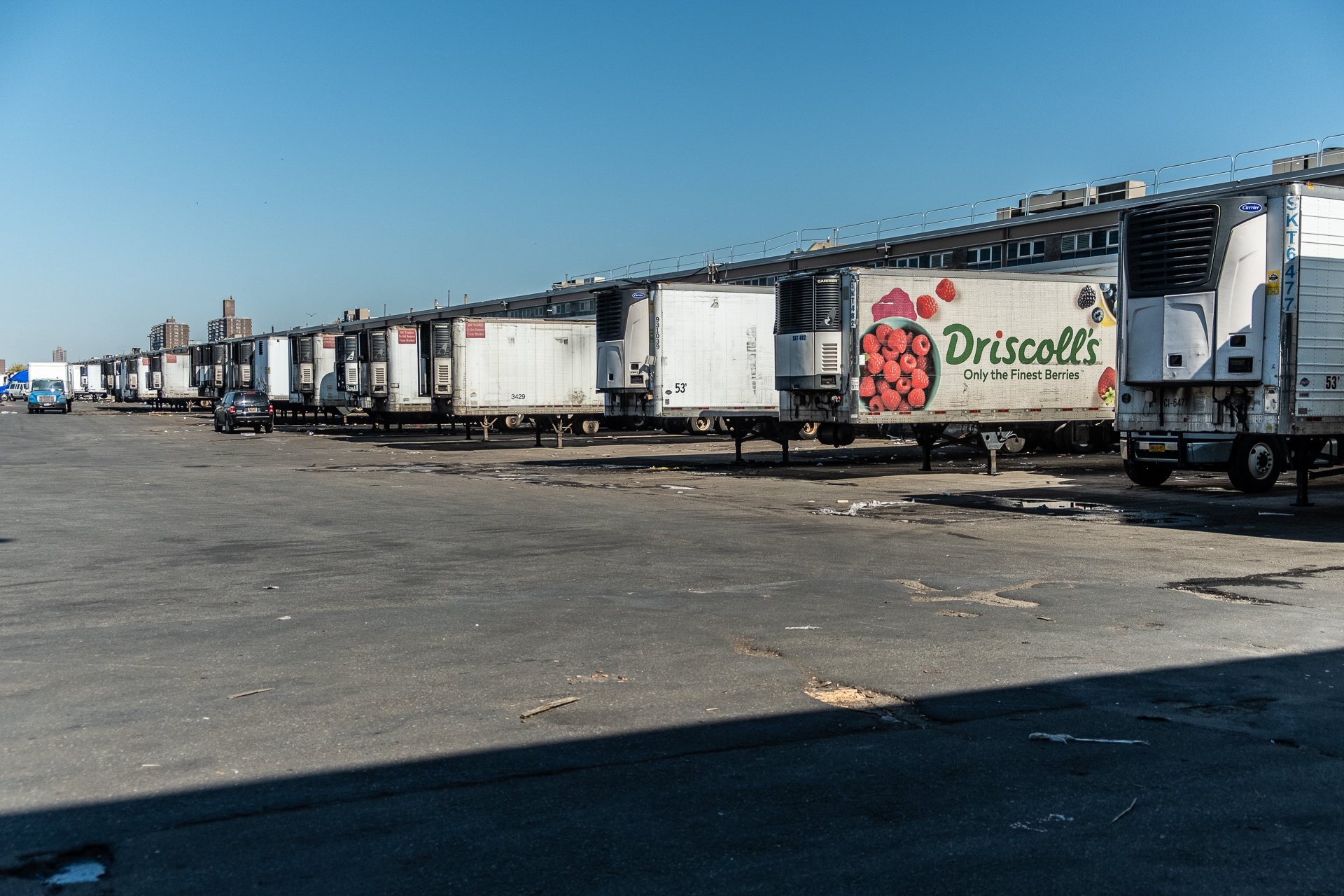
In both COVID-19 and Hurricane Sandy, truck-based transportation was hugely disrupted, between fuel shortages, bridge and tunnel closures, and heavy traffic. The NYC Food and Climate Strategy—a roadmap released by MOFP in 2025 to reduce the food system’s environmental impact and strengthen its resilience to climate-related disruptions—estimates that 95 percent of food travels into the city by truck via limited access points, with nearly 30 percent of George Washington Bridge truck traffic believed to be carrying food.
The Strategy guide calls for the city to “proactively address our continued reliance on truck-based food distribution.” This would involve expanding alternative transportation modes, like ferries and cargo bikes, alongside investments in micro-freight landings—small neighborhood hubs where larger shipments can be transferred to smaller vehicles—and the revitalization of underutilized ports.
It also calls for a complete redevelopment of Hunts Point Food Distribution Center in the Bronx, the largest food distribution hub in the country, to harden buildings at-risk from flooding, and implement continuous and back-up power at the facility, which it does not currently have. During Sandy, Hunts Point was spared from the worst of the floods, but its positioning makes it extremely vulnerable to flooding.
The quality of food, or lack thereof, was another wake-up call during Sandy. Large aid shipments of meals often arrived without refrigeration or cultural fit.
“The federal government’s response is to send in meals ready-to-eat, which is typically what’s served in the military,” said MacKenzie. “If you looked at the nutrition label, it was awful. It was like the food served in war times, but we weren’t living in war times.”
Non-governmental food aid excels at filling gaps that policy neglects: culturally appropriate food (kosher, halal choices), multilingual staff, no-ID requirements. New York’s community food programs such as private and nonprofit food pantries, mutual aid groups, community fridges, soup kitchens, and more, feed hundreds of thousands weekly in “normal” times. In crises, they expand reach in an attempt to meet increasing demand.
“Since COVID there’s been major growth in mutual aid, free fridge networks, general community response, thinking about how we can protect our neighbors who can’t go outside with ICE,” said Neff. “And I think, both within the government and just the general population, there’s much more understanding of food as a critical need that doesn’t get automatically met if we don’t do something proactive.”
But there is still a gap in capacity, as pantry budgets rely on donations and modest city grants. Equipment and trucks are often insufficient to handle the volume of food, meaning many donated items spoil quickly.
The Bronx-based New York State Regional Food Hub, completed last June and operated by GrowNYC, goes a long way to providing more cold storage and landing places for regional farmers to sell in New York City. The 60,000-square-foot cold storage facility can connect mid-sized farmers to 370 food distribution partners including pantries, schools, senior centers, grocery stores, restaurants, bodegas, and other community organizations, across the boroughs.
As far as funding goes, the federal Supplemental Nutrition Assistance Program (SNAP) is the largest hunger safety net, and its approximately $186 billion cut in funding over the next 10 years through the “One Big Beautiful Bill Act” (OBBBA), gives the city a gaping hole to fill.
City Harvest projects New York City could lose 250 million meals a year, as 1.8 million neighbors fall off SNAP.
“It’s hard for a city or state to cover billions of dollars of lost food assistance,” said Max Hoffman, associate director of supply chain, procurement, and logistics at City Harvest. “The city is fairly well-prepared, but these cuts are at a scale the city and state cannot likely make up for.”
“The only silver lining is that it’s going to take a year or two,” Hoffman added. “And City Harvest is looking forward two, three years down the line and trying to figure out how we can set ourselves up for success when faced with a food insecurity crisis, which we’re already in, to be clear. We want to be ready to drastically increase pounds if necessary. We do not want to get caught flat-footed.”
While city and state hunger prevention programs pale next to the loss of a billion-dollar federal program, they are still rallying in response, which also helps bridge that gap.
The most recent state budget included $72.8 million for the Hunger Prevention Nutrition Assistance Program (HPNAP), and another $55 million for NourishNY, up from just $8 million each pre-pandemic. Those programs fund food banks and buy local farm produce.
A perhaps unexpected issue that accompanies disasters is prolonged distribution of free food, which ends up undercutting neighborhood grocers.
“Knowing when an emergency is over is so important,” said MacKenzie. “People feel such a pull to help people, that when you tell people to stop, it’s hard to do. But stores need to come back to business, and the flood of free food can actually be detrimental at some point.”
Another lever of systemic resilience is procurement within large public agencies like schools, prisons and hospitals. These institutions buy massive quantities of food, typically at the cheapest price they can get, per the New York State General Municipal law 103, which restricts municipal agencies to purchasing from the lowest bidder. That means that these are often non-local goods produced in environmentally and/or socially detrimental ways, which has implications beyond sustainability.
When supply chains or transportation routes are disrupted during emergencies, a more diversified network of regional suppliers that serve institutional needs can have a direct impact on food access.
“Because of that restriction we were bound by what we could pass at a local level,” said Ribka Getachew-McLean, director of the NY Good Food Purchasing Program (GFPP) Campaign. “And so that led us to building out a statewide campaign, which essentially was trying to respond to that restriction and also worked to learn what restrictions other cities, municipalities and localities were experiencing around the state.”
The GFPP is a procurement framework that helps public institutions like schools, hospitals, and cities purchase food based not only on price but also on values like local economies, environmental sustainability, fair labor practices, animal welfare, and nutrition.
These efforts led to the drafting of the Good Food NY bill, which aims to address the lowest bidder requirement by enabling public institutions on the municipal level to spend 10 percent higher on a New York State food producer or farmer that aligns with set environmental or social standards.
Another aspect of the bill is its requirement for any bidder to submit supply chain data to the institution. The bill does not impose a mandate from the state, rather it enables municipalities to opt in, and decide if they want to pass strong local policy.
The bill passed the Senate and Assembly in 2024, but was ultimately vetoed by Gov. Kathy Hochul. The legislature again passed a version of the bill in June, which advocates are urging the governor to sign by the end of the year.
Change may be gradual from there, as many institutional contracts last three to five years, but will trend toward more transparent, local, environmentally sustainable, and ethical sourcing.
“We’re oftentimes using the phrase, ‘leveraging the power of procurement,'” said Getachew-McLean. “And we’re essentially saying that large public institutions are spending so much money on food. And so just from a simple supply and demand perspective, and because of that interplay between public institutions and food companies, agencies can ultimately influence those companies or suppliers to adhere to practices that are in line with the agency.”
These practices could range from the values that are upheld in the Good Food Purchasing Program, like supporting local economies, producers, climate resilient farmers, farms that provide living wages, have strong animal welfare practices, etc.
It’s important to consider the difference between short-term and long-term disruptions. Local networks must work in concert with robust public funding and effective policies; our ability to withstand crises depends on it.
“Building food system resilience requires broadening our focus beyond acute weather disasters alone to comprehensive adaptation for both sudden shocks and chronic stresses,” said MacKenzie.
To reach the editor, contact [email protected]
Want to republish this story? Find City Limits’ reprint policy here.