


An increasing number of family homes in the outer boroughs are sold within two years of being bought—at huge markups. As New York City’s housing market continues to tighten, some lawmakers say the tactics are predatory, targeting neighborhoods with Black homeowners.
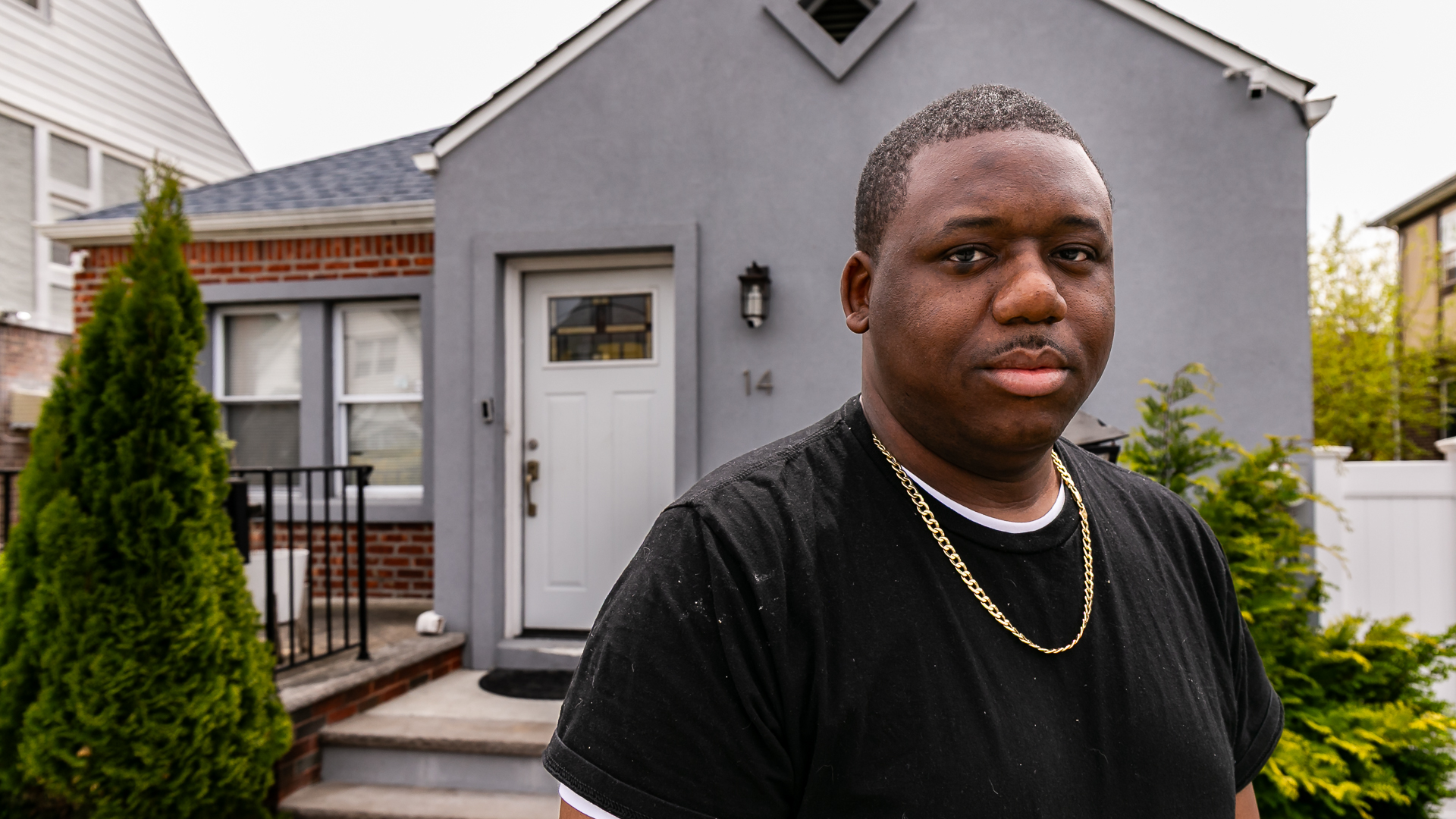
Lorne Wright, 38, bought his home on 132nd Avenue in South Jamaica in 2022. As home prices exploded in the neighborhood, he was grateful that he, his wife, and two kids bought when they did. Some listing sites estimate the Wright home is now worth close to $1 million.
But less than a year before the Wright family purchased it for $700,000, a company called “The Jamaica Partners 132 LLC” bought the home for $285,000.
The transaction is a textbook example of a “flip”: a practice that researchers say is growing more prevalent in New York City, where investors buy homes below market price and resell them within one or two years for massive markup.
Some flips are above board, taking homes that need work, fixing them up and reselling them. But in some cases, advocates say, home flippers use predatory practices, harass homeowners, and lowball vulnerable residents in order to maximize profits.
And researchers and legislators are concerned that flippers are targeting neighborhoods like Wright’s: havens of Black homeownership in an increasingly expensive city.
“It’s a good and bad thing,” said Wright. “As a property owner, yes, the property value goes up. However, the more we go up, a lot of families aren’t able to afford it.”
Real estate investors say they are simply following the market, renovating homes that need repairs, and responding to demand for housing.
But prospective homebuyers say it pushes longtime residents out and puts homeownership out of reach for families who can’t compete with investors making all-cash offers.
“I don’t know if anything can be done or which things could be done about it,” said Wright. “There are a lot of families who [homeownership] is their dream—the American dream—but it’s no longer obtainable.”

One block, five flips
Not every home flip looks the same. Some are homeownership properties and some are rentals; some are duplexes and some are postage-stamp single family lots; some are fully gutted, boxy McMansions and some are untouched gabled-roofed two-story homes; some sell for a huge profit and others don’t break even; some are scams and some are investments.
132nd Avenue is a charming block a short walk from the Locust Manor Long Island Railroad stop, nestled next to the quiet, unlandscaped Gwen Ifill park. The homes have manicured lawns and pitched roofs, often with wood siding above stone first-floor facades. It’s suburban living within city limits, with clear sidewalks, short, stubby driveways, and ample street parking.
Two doors down from the Wrights, Olivia, 23, has lived with her mom and three younger siblings for six years. They rent a three-bedroom unit on the second floor of a duplex apartment. Their rent went up $300 this year, to $2,800 a month.
Their home was flipped in 2022, according to data from the Pratt Center for Community Development. It’s one of five homes, including Wright’s, on just one block of 132nd Avenue between 178th and Garrett streets that were flipped in the last five years, according to the group’s analysis.
All were resold less than a year after they were purchased. Four were flipped for a profit that ranged from $220,000 to $500,000. Four also used an LLC to purchase the home and sell it to a new owner.
This strip of South Jamaica is one of the city’s hotspots for flipping, according to researchers at the Pratt Center. Pratt classified flips as any one- to three-family homes resold within two years of purchase.
In Queens’ 12th community district, which encompasses Jamaica and Hollis, 21 percent of one- to three-family homes sold in the area between 2021 and 2025 were flips, according to the Pratt Center—over 1,400 properties.
More than 10,000 homes citywide were flipped during that time period, and were more likely to be located in predominately Black neighborhoods, according to the center’s new report.
The census tracts that had flip rates of over 8 percent were 47 percent Black, according to the report, while those with low flip rates were just 10 percent Black.
“Home flipping is indicative of larger racial inequalities in our housing market,” said Sylvia Morse, director of research and policy at the Pratt Center.
Rev. Christine Valentine has owned a home in East New York for 21 years, and is on the steering committee for the neighborhood’s Coalition for Community Advancement. Over the years, she says, the area has been a target for real estate investment that accelerated gentrification and pushed people out.
“Speculative home flipping is accelerating the disappearance of Black communities… speculators especially targeted communities with a lot of populations of people of color, especially senior homeowners and other vulnerable groups,” she said.
New York City has lost nearly 200,000 Black residents in the past decade. And while neighborhoods like Jamaica and Hollis have long been strongholds of Black homeownership, the number of Black residents there declined from 72 percent of the population in 2000 to just 55 percent in 2023, according to data from the NYU Furman Center.
The high cost of housing and the dearth of affordable homeownership opportunities are a big factor, residents say.
“That’s why a lot of people are leaving for [Pennsylvania] and New Jersey,” said Wright. “Less families are able to move in. There are barely any kids on the block because of that.”
What makes a flip ‘toxic’?
Every week for years, sometimes multiple times a day, homeowners in the fast changing neighborhoods of East New York, Cypress Hills, Jamaica, Hollis, and Ozone Park, have been getting calls from real estate agents or companies asking if they’d like to sell their home.
“I get text messages, phone calls and even one LinkedIn DM from real estate speculators trying to purchase my home,” said Farrah Lafontant, a homeowner in East New York since 2006.
Margaret S., who lives in Rochdale, Queens, said that she and her husband have gotten calls, flyers, and the occasional door knocker for years. She said the tactics have gotten aggressive. “There’s a lot of underhanded stuff going on… it’s out of control,” she said.
In response, several community groups formed the “Coalition to End Toxic Home Flipping” to push for policy changes that would limit predatory practices.
But what makes a flip “toxic” instead of just an investment?
Advocates say flippers are defined by their tactics. It starts with calls, door knocking, and flyers. But in some cases it can be more insidious, researchers say, targeting families with recently deceased homeowners, buildings that have active eviction cases against tenants, or physical distress like housing code violations.
The Pratt Center’s Morse said that those anecdotal reports, combined with the types of neighborhoods where they see the most flips, makes it likely that flippers are targeting some of the most vulnerable homeowners in the city.
“We would like to pass our homes down to our children and grandchildren, but if we are getting harassed to sell them due to whatever our financial situation is, we’re losing generational wealth,” said Valentine.
The tactics remind some of those used by deed thieves, who use deception to intervene in succession of homes or trick homeowners into unknowingly signing over their properties.
Mayor Zohran Mamdani established an office to prevent deed theft last month after City Councilmember Chi Ossé was arrested trying to block the eviction of a constituent he said was a victim of the practice (though other elected officials have disputed whether the case meets the definition of deed theft).
“Every story is different, complicated. There are unique circumstances. The issue is that this is a business model that clearly we can see,” said Morse.
Deaths, liens, and other public signs of distress can be catnip for predators, advocates say.
In cases where predatory tactics are at play, there are victims on both sides of the transaction: a seller in distress and a buyer with few other options.
When The Jamaica Partners 132 LLC bought the Wright home in 2021, it did so for just $285,000 from the estate of Helen Dollar, who passed away before 2017. The property was in foreclosure and the heirs sold it to a home flipper at well below market value, in what experts said bore the hallmarks of a potentially predatory sale: a low offer, an heir facing foreclosure, and signatures on deed documents that hide a buyer’s identity.
“This is a typical example of the kinds of predation that we see on estates and distressed homes, homes that are in foreclosure … preying on people, survivors and heirs and families after somebody has passed away, to essentially strip the equity of a home, using misrepresentations and misinformation to appropriate that inherited family wealth,” said Scott Kohanowski, general counsel at the Center for New York City Neighborhoods.
Predation isn’t involved in every home flip, said Kohanowski. But flippers are looking for an edge to be able to buy below market and sell above.
“They’re going to buy distressed properties, whether it’s due to violations, tenants, physical condition, whatever there may be,” said Sunil Agarwal, a lawyer who works with clients investing in real estate.
To him, buying low and selling high is just business.
“Everything in life is a flip. When you buy a cup of coffee in the morning, that’s a flip. $5! Did it cost them $5 to make it?” said Agarwal. “People, unfortunately, just associate that with real estate. But flip is really profit, so I don’t think it should have a horrible connotation. It’s just using that in the one context as a dirty word.”
Flipping isn’t new, but the practice is gaining more scrutiny as New York’s housing crisis persists.
“We knew it had been flipped,” Jessica Franco said of the home she bought in Cypress Hills in 2014. The home sold for around $200,000 just before Franco and her family bought it for $600,000.
“We were getting the short end of the stick. And at the moment, we felt like, if we didn’t buy something, we were gonna not be able to find something,” said Franco.
Other homeowners report that the flipped homes they bought had largely cosmetic changes, designed to push up the home’s value.
Wright says that his home was advertised as freshly renovated. When he first moved in, there were some obvious changes: renovated interiors, a new front path, and a new coat of paint—dark gray—that some observers have dubbed “gentrification gray.”
But he soon found it wasn’t in as good of shape as he thought.
“It was redone and sold in a year. It was definitely a rush job,” said Wright. The family spent between $20,000 and $30,000 on redoing windows, floors, the roof, and steps in the first year they lived there, Wright estimates.
“We shouldn’t have had these issues,” he said.
But Agarwal said that people raising the alarm over big profits between home sales are missing the fact that many of the homes need significant repairs. Those renovations, he says, help the whole neighborhood.
“I’m pro-gentrification. Gentrification is improvement. You’re improving,” said Agarwal. “Of course the price is going to go up. It should go up. The homes are improved. The neighborhood is improved. You can’t expect that somebody’s going to spend all this money to improve a home, improve a neighborhood, and then charge exactly what you made for it. That makes no sense.”
Researchers counter that the tight renovation timelines, usually from investors living outside the community, do not signal investment in the community, but wealth extraction.
“In the context of overall lack of access to capital, the challenges that we know people of color, particularly Black people, face in accessing financing and resources to improve their homes over time, all of these things that create a nexus of vulnerability for these kinds of investment tactics,” said Morse.
The rise of home flipping has followed two other trends in New York City real estate: the rise of the LLC buyer and the rise of the all-cash offer.
When Franco and her husband considered moving again recently, they quickly realized that they couldn’t compete in today’s market.
“We could show up with our pre-approval letter from the bank, and it’s never going to match up with an offer from an all cash buyer,” said Franco.
All cash offers, which are becoming more prevalent, are more likely to be made by investors or high net worth individuals than families.
“People can’t compete. And so what is happening is that those properties now become unattainable for people who grew up here,” said Councilmember Sandy Nurse, who represents parts of Bushwick, Ridgewood, East New York, and Cypress Hills.
Who’s flipping homes?
BSD Home Solutions LLC bought a home on 176th Place just around the corner from Wright’s for $660,000 in 2022.
Ian DaCosta, an electrical engineer for the MTA, bought it for $1.2 million less than a year later.
The home underwent a significant renovation that added an expanded second floor. But DaCosta said the work was shoddy. “Terrible job,” he said. “Just cosmetics look good. That’s about it.”
When he closed on the house, he said the chimney wasn’t finished and didn’t clear the new, higher roof. He found trash inside an interior wall he took down after he moved in. And when he ran some wiring for a security camera, he discovered there wasn’t insulation or home wrap under his siding, he said.
“Not every builder does [a bad job],” said DaCosta. “We come to find out the investors, a big investment company, they take a hands off approach.”
Home flippers can be hard to track. Most use limited liability companies (LLCs), like BSD Home Solutions, to purchase properties, a structure that limits risk for investors but also makes it difficult to identify buyers and sellers because corporation registration information is not public.
In recent years, large institutional investors have entered the market for single family homes around the country—and in New York City—and policymakers on both sides of the aisle, from Gov. Kathy Hochul to President Donald Trump, have sought to curb some of their practices.
But it appears that many of the homes flipped in New York are done by smaller-time investors—or that bigger investors have gotten better at hiding it.
Nevertheless, using shared business addresses and deed documents, City Limits identified several more sophisticated investor groups that flipped hundreds of homes around the city since 2019.
One of them, Empire Home Sales, sold to DaCosta. Empire Homes and its chief Roy Toledano, declined to comment for this story.
Empire Homes’ business address in Kew Gardens was associated with over 122 flips identified by the Pratt Center between 2019 and 2025, the overwhelming majority of them in Southeast Queens.
Another investor group, with a business address that matches Plaza Homes LLC in Jamaica, flipped 82 homes over the same period. Representatives from Plaza Homes declined to comment.
But those larger investing networks accounted for just a few hundred of the more than 10,000 New York City homes that were flipped from 2021 to 2025. Most local flippers, it appears, are smaller operations.
“There’s some who are operating on a very large scale… And then there are probably some who just find a good deal, and they game it they might make a few $100,000 and they might just keep doing that,” said Scott Kohanowski, general counsel at the Center for New York City Neighborhoods.
But the flipping industry has nonetheless been professionalized to some degree.
“If it were just sort of a regular part of the housing market, we probably wouldn’t see such different rates of home flipping in the neighborhoods that we do,” said Morse.
Agarwal said investors are just following the market. “Very simple: It’s a question of there’s a finite amount of housing and the population is exploding,” he said.
The business address for his law firm on Nostrand Avenue in Brooklyn was the address of record for parties in 84 transactions flagged by the Pratt Center as flips since 2021, with Agarwal’s name often appearing in deed paperwork on behalf of LLCs associated with his business address.
Researchers at Pratt say that the business tactics of firms like Plaza and Empire Homes actually drive up prices.
“Consistently over the past five years, we saw that the price of flipped homes is higher than non-flipped homes,” said Morse. “We’re in a housing crisis, locally, nationally, housing prices are going up, but flipping is driving up home prices more.”
Costs for single family and small homes in Jamaica have doubled since 2010, according to data from the Furman Center. But home sales have actually slowed in recent years, perhaps due to persistently high interest rates.
Four homes along 132nd Avenue identified as recent “flips” by Pratt Center’s research. (Adi Talwar/City Limits)
Where some see speculation, Agarwal sees opportunity.
“This is not just how it is in Queens but everywhere there are pockets, where there’s been a greater increase [in home values], but at this point, we’re not close to the upper limit,” said Agarwal.
“The entire system—it’s a game,” said DaCosta. “A lot of people in America have a lot of money and they want to be here … so you can’t say just because of the investors at the end of the day, they’re responding to the market.”
Whether or not flipping actually pushes prices up, or simply responds to already rising demand, researchers suggest that the tight housing market creates incentives for bad behavior from investors—and have some ideas about how to fix it.
What do legislators want to do about it?
In 2020, the state established “cease and desist” zones in parts of Brooklyn where homeowners could sign up to be put on a do-not-call list for home solicitors. But the zones expired in November, and haven’t been renewed.
“That did decrease the amount of solicitation that my neighbors and I were receiving. But prior to 2020 it was certainly very intense. And I would say it started to pick up again,” said Franco.
Legislators want to see cease and desist zones restored and expanded, arguing it would help curb predatory tactics and harassment by real estate investors.
But they also want to take aim at the underlying financial incentives for flips. State Senator Julia Salazar’s bill, the End Predatory Home Flipping Act, would tax homes that are resold within two years—at 65 percent of the difference between the original sale and the flip if it’s sold within the first year, and 50 percent if it was sold within the second year.
“This is a predatory practice that is driving up the cost of homes and rent, particularly in neighborhoods of color like East New York and Cypress Hills,” said Salazar.
Real estate groups are opposed to the tax, arguing it would hurt their ability to invest in renovations and do nothing to increase the supply of housing in the city, hurting both homeowners and renters during a housing shortage.
Some also suggested it would actually increase the price of housing, as real estate groups would price in the cost of the tax and pass it on to homebuyers.
In an opposition memo, the New York State Association of Realtors said that a tax would create an additional burden in New York, where there are already closing, transfer, and mortgage recording taxes on residential sales.
“While the intent of this legislation may be to address affordable housing in New York City, it is misguided and will not create a single affordable housing unit. New real estate taxes simply make home-buying more costly,” the group wrote in 2023, adding that the tax “will drastically curtail investment in aging properties and other residential real estate.”
And the tax could apply to a broad swath of buildings. Pratt identified over 10,000 flips between 2021 and 2025, and many of those could be taxed—though legislators outlined several key exemptions for transfers between family members, owners that can prove some hardship, or sales where the markup is 10 percent or less.
Still, the bluntness of the tax might be the point to some. “Flipping is happening and we’re reaping no benefit from it,” said Councilmember Nurse.
Whether you are a small-time investor or professionalized flipper, “a flip tax is a way to account for all motives,” she added.
“Financial attacks on the flip would slow down this a little bit and create a little bit of disincentive and maybe create an opportunity for working families here to be able to purchase,” Nurse said.
It’s not clear if flipping can be stopped. In the throes of a deep housing crisis, sky-high rents emanate out through the city. Communities like South Jamaica are seeing those transformations accelerate.
“The one constant in life is change,” said DaCosta.
For prospective homebuyers, the biggest change might be a growing shadow of helplessness, feeling like homeownership in New York City is harder to attain than ever.
“They’ve worked really hard to make their communities, these Black suburbs,” Nurse said of neighborhoods like her district in Brooklyn and Southeast Queens. “And they’re beautiful, they’re gorgeous.”
To reach the reporter behind this story, contact [email protected]. To reach the editor, contact [email protected]
Want to republish this story? Find City Limits’ reprint policy here.