


Share This Article
Maria Guzman, 71, said she couldn’t believe that a man who helped her garden for a few minutes one afternoon would, within weeks, donate millions of dollars to redesign 33,000 square feet of outdoor space at her public housing campus.
Williams)
Maria Guzman, a 71-year-old public housing resident of Harborview Terrace Houses, and her grandson were shoveling dirt out of old planters at her complex when Bill Ackman—the founder of Pershing Square Holdings and its charitable arm, whose net worth is estimated at nearly $9 billion—walked by on his way to work one morning in 2022.
“I met this man who I knew nothing about,” she told City Limits, and when he asked her what she was doing, she said, “I was a little sarcastic.”
“What do you think I’m doing, shoveling,” she said she replied. When Ackman noticed she was working on her own, she said, he offered to help out for a few minutes. “I said thank you, and that was it,” she said. “He didn’t say much.”
A few weeks later, Guzman, who is also the development’s tenant association president, received a call from the executive director at the Public Housing Community Fund (PHCF), a nonprofit that facilitates the design and construction of public projects that are funded by private donors. The director told her the man she met wanted to invest in the open space area at Harborview Terrace—if residents would help plan the designs.
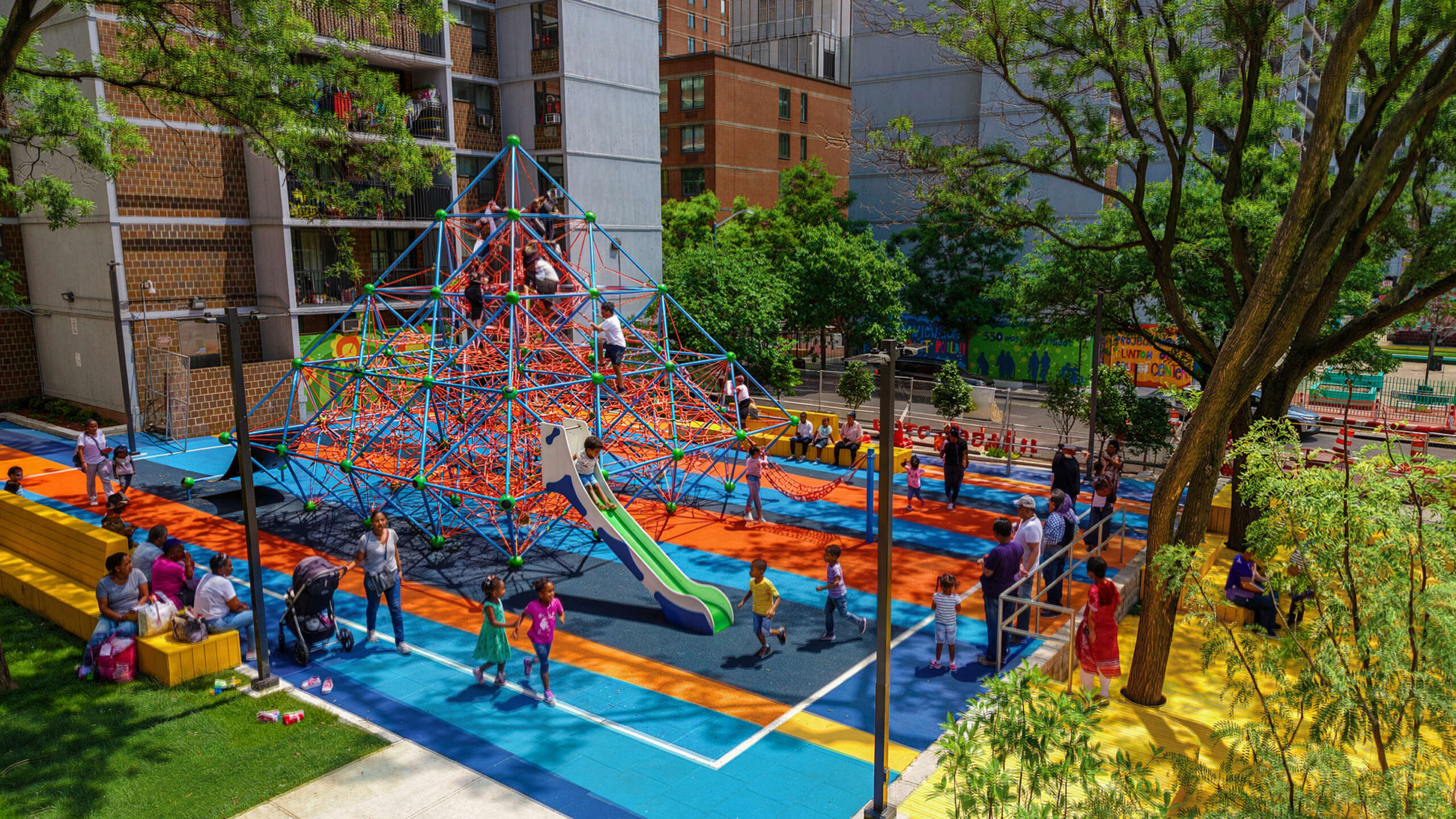
The chance meeting on the Hell’s Kitchen housing campus was the start of a nearly $4 million series of projects, completed this summer, to redesign 33,000 square feet of the development’s outdoor space. It includes additions like a massive playground, outdoor gym, basketball courts, water play areas, planters and seating, and NYCHA’s first pickleball court—all constructed in a fraction of the time it takes publicly funded projects to get done.
Three main groups worked together, along with NYCHA and a contracted construction company, using a public-private funding model where one group offers upfront design services, another provides funding, while a nonprofit oversees and manages the construction, effectively taking all of those burdens off the public housing authority.
Two of those groups—Grain Collective, the urban planning practice that drew the designs for the Harborview Terrace project, and PHCF—have now collaborated on three similar open space projects. They believe the funding model can deliver completed renovations sometimes years faster than fully publicly funded projects, while affording designers the time to collect deep resident engagement.
Their effort comes as officials and residents debate the role of private entities in the city’s public housing, as NYCHA transitions tens of thousands of its apartments to private management under Section 8, part of a controversial program to unlock additional repair funds.
Grain Collective and PHCF, however, focus on projects for traditional public housing developments, or those that are still in the fully-federally funded Section 9 program, which often have less funding than those converted to Section 8.
“We want this model to get out there in the world, especially in New York City, so we can deliver more projects for residents who are underfunded,” said Runit Chhaya, the founding principal of Grain Collective, which drew designs for the playground and outdoor space.

The public-private partnership funding model
Chhaya explained that when a private donor wants to use their money to fund a public project, like one on a NYCHA campus, the plans must go through a nonprofit group—like PHCF.
In 2016, the housing authority created PHCF as a nonprofit agency that could work directly with interested funders, including private or governmental sources, to oversee certain construction projects—removing that burden from the housing authority, which is often bogged down with addressing more dire or pressing structural needs across public housing developments.
“Grain and Public Fund took over that construction manager responsibility,” Chhaya told City Limits. “It’s a mean, lean team which is able to move faster. A speedboat moves faster than a ship, as simple as that.”
“It’s not that NYCHA staff is the problem,” he added, “but it’s a giant thing that takes a long time to move.”
In addition to Ackman—a billionaire hedge fund manager who poured more than $1 million into the last mayoral election, in support of former Gov. Andrew Cuomo—PHCF’s past donors include major corporations like Deutsche Bank as well as individual givers, like former de Blasio administration official Alicia Glen, according to the group’s website.
“This partnership is a model for how public–private collaboration can transform our built environment and strengthen New York City,” Ackman said in a statement about the completed plans.
Grain Collective and PHCF have now collaborated on three open space projects, including the completed renovations at Harborview Terrace as well as NYCHA’s first dog park at Castle Hill Houses in 2025. They’re currently working on a fourth project to renovate a playground and splashpad at Pomonok Houses in Queens.
Having worked with PHCF in the past, Chhaya said the group “offered our design services in the beginning on a pro bono basis, and once the funding was secured, we were officially brought on board with all the fees and everything.”
Another important focus of the partnerships, according to Alex Zablocki, executive director of PHCF, is to deliver projects to traditional public housing developments that don’t have as much funding as the more than 39,000 apartments converted into private management under federal Section 8.
“NYCHA has limited federal funding, and they tend to focus on a hierarchy of needs that includes lead, asbestos, and mold remediation, things that are important for the building envelope,” Zablocki explained. “With scarce resources, the housing authority typically doesn’t invest to reimagine open spaces, and that’s where partners like us come in.”
Virtual reality glasses and votes: cultivating deep resident input
From there, Chhaya said, the groups began to develop “deep community engagement, where residents’ voices were front and center of the whole discussion,” he said. “That’s how everything evolved.”
They held about eight large and small resident meetings over a year, plus regular calls with the tenant association, and held votes on everything from big picture designs down to the color of paint used on the benches.
“They all chose the colors of the play equipment, which turned out to be Knicks colors,” Chhaya said. “That was pretty remarkable because the week the Knicks won, we opened the park.”
On one occasion, residents used virtual reality glasses to glimpse what the designs would look like in real life. Guzman told City Limits it was “like science fiction.”
“Our building is built above the Amtrak tracks,” she described. “We don’t have a huge foundation. The benches were already sinking, there were holes where the old tables and benches were, and a huge amount of rats.”
“It looked so grand and so big that I didn’t think they would have enough room to make it all fit,” she said of the design plans. The groups also held an ice cream party in April, and despite what Guzman described as “torrential rain,” over 100 residents showed up to vote on colors for the new equipment.
Ayestaran)
Chhaya believes the speed and efficiency of the project inspired residents to get involved. “When they saw that this was moving fast without getting dragged through the mud, they came to the table,” he said.
Guzman told City Limits that at first she didn’t believe the groups would adhere to the 16-month time table they were proposing.
“I’ve been a president here for over 20 years,” she said. “There’s a feeling that you kind of don’t believe you’ll get the things that are promised, but the Public Fund kind of shut me up.”
Chhaya said discussions with residents often “became very personal in some ways.”
“We would talk about whether we are exploring the right materials, things that won’t be burning hot in the sun, are we making sure every dollar is getting invested in the right way, and not doing frivolous things,” he said.
Recent additions line up with Harborview Terrace’s 50th anniversary
The project at Harborview Terrace consisted of two phases, totaling $3.8 million, and was completed this summer, which coincides with its 50th anniversary as a public housing development. Guzman told City Limits she has been a resident of the Harborview Terrace Houses for nearly as long.
“I’ve been a proud resident of the development since 1976,” she said. The improvement project “does a lot for the morale of our tenants,” she added.
“One of my phrases that I use at every meeting is ‘Your living room begins at the entrance of your building,'” she said. “That’s the first step into your living room.”
The first phase of work was a $200,000 redesign of the development’s basketball court, which started in July of 2023 and was completed by November of that year. The second phase was a much larger, $3.6 million transformation of the entire campus’s open space, which was delivered in 16 months.
Pershing Square Foundation, Grain Collective, and the Public Housing Community Fund worked together on that second phase, which includes a new playground, plaza, outdoor gym, and upgraded recreational space.
“We are proud to partner with the Public Housing Community Fund and provide the resources to support our neighbors at NYCHA’s Harborview Terrace in shaping their community and bringing their vision for this space to life,” Ackman, whose firm Pershing Square Holdings is based nearby, said in a statement. “Our hope is that others will be inspired to invest in their own neighborhoods across the city.”
The impact of the new space, according to Guzman, “has meant the world to Harborview.”
“I have people coming from all over the neighborhood with their kids telling me it’s their new favorite place,” she said. “That’s what this was built for, the kids love it, and we are forever so grateful.”
To reach the reporter behind this story, contact [email protected]. To reach the editor, contact [email protected]
Want to republish this story? Find City Limits’ reprint policy here.