


Share This Article
New affordable housing is still concentrated in lower-income, high-density communities, while other areas see little to no development. “We’re not yet seeing more equal distribution,” said Brendan Cheney, director of policy and operations at the New York Housing Conference.
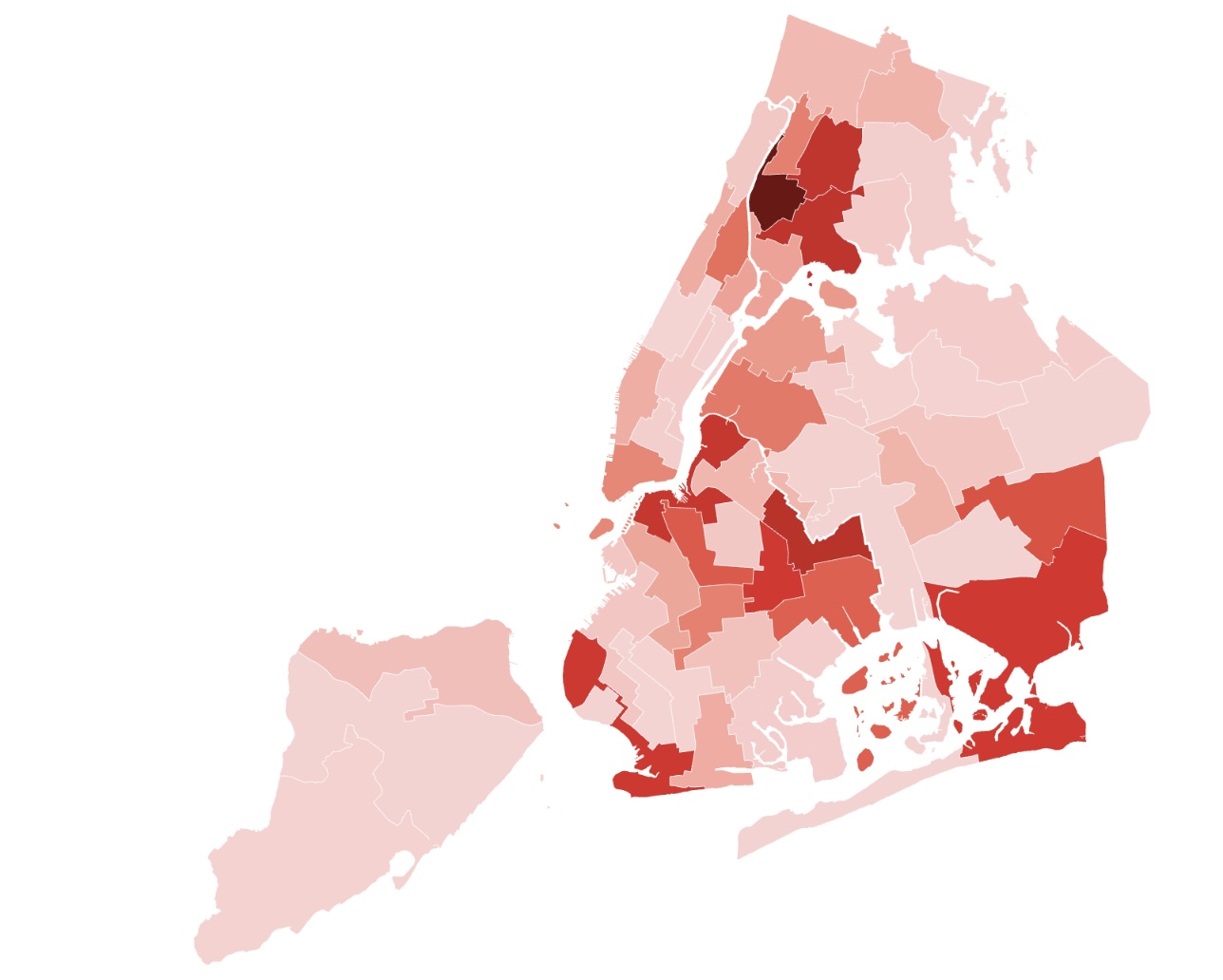
New York City produced a total of 29,721 affordable housing units last year, both through new construction and preservation efforts, according to a report released by the New York Housing Conference (NYHC) this week
The new apartments continue a trend borne out in the data over the last several years: the city’s new affordable housing is still concentrated in lower-income, high-density communities, while other areas see little to no development. That’s despite recent city efforts to spur new construction across the five boroughs to help address a record housing shortage.
“We’re not yet seeing more equal distribution,” said Brendan Cheney, director of policy and operations at NYHC. “If more neighborhoods were doing their part, were building more housing, we could increase the supply faster to meet the demand and have a more balanced housing market.”
The NYC Housing Tracker breaks down which City Council districts produced the most affordable housing through subsidy and tax abatement programs. Developers added 13,605 affordable units through new construction, 13 percent less than in 2024 but still 9 percent greater than the average over the last five years.
In 2025, 10 districts produced more than 525 affordable units, located in the central Bronx, eastern Queens, and parts of Brooklyn. These districts accounted for almost two-thirds of the affordable housing produced last year. On the other hand, two districts—one covering the Upper West Side and another in south Brooklyn—produced zero units of affordable housing.
Council District 16 in the South Bronx saw more new affordable units than any district—with 1,915—more than double the 939 units built in north Brooklyn’s Council District 37, the second highest.
Although the last couple of years have seen sweeping housing policy changes, the report indicates that they have not yet played a role in new development.
Those changes include the passage of former Mayor Eric Adams’ “City of Yes” plan, which made citywide zoning reforms aimed at making it easier to build more housing. Similarly, the replacement of the 421a tax abatement with the 485-x program has still not led to any noticeable changes in affordable housing distribution, according to Cheney, despite increased affordability requirements.
In addition, a series of ballot measures that voters approved in 2025 will likely impact affordable housing generation in future years, and could correct some of the disparities across different areas of the city.
The report also tracks the cumulative construction of affordable housing from 2014 to 2025, with Council District 15 in the central Bronx, represented by Oswald Feliz, holding its overall lead from last year, with 8,728 units built over that time. By contrast, four districts—two in eastern Queens, one in south Brooklyn, and one in Staten Island—have built fewer than 100 affordable housing units over the past decade.
Most of the districts that add very few affordable housing compared to the rest of the city are less dense and poorly connected to public transportation. Even so, Cheney says there is room for development in those communities that fits in the context of the neighborhood.
“You can see in the data that one or two projects can make a big difference in terms of how much housing is in a neighborhood, especially in a low-density neighborhood,” said Cheney.
Here’s what else happened in housing this week—
ICYMI, from City Limits:
- Mayor Mamdani and the City Council reached a deal late Monday to expand city-subsidized rental assistance as part of a larger budget agreement. Thousands of new households will be eligible for vouchers under the expansion, but the scope is far smaller than lawmakers originally intended.
- Mainchance, a longtime drop-in center for the homeless, closed Tuesday after a prolonged fight with two mayoral administrations to stay open. Some elected officials worry that closing the center will create a gap in the network of homeless services in high-trafficked Midtown, especially as the city moves the system’s nearby central intake shelter, Bellevue, to the East Village.
- Beginning this summer, building owners will be able to offset some of their carbon emissions in accordance with Local Law 97, the city’s framework for reducing pollution from buildings, by purchasing credits associated with a new renewable energy project.
ICYMI, from other local newsrooms:
- A Section 8 paperwork screwup resulted in hundreds of NYCHA tenants getting erroneous eviction threats from the private management companies in charge of their developments, according to The City Reporter.
- The city’s annual point-in-time street homelessness count found a record-high number of people sleeping on the streets this year, according to Gothamist.
- “I’m very, very concerned that people are going to die because of this level of heat,” Dave Giffen of the Coalition for the Homeless told the New York Times, as dangerously high temperatures engulf the city.
- A federal appeals court upheld New York State’s All-Electric Buildings Act, which bans polluting fossil fuel hookups in new building construction, NY1 reports.
To reach the reporter behind this story, contact [email protected]. To reach the editor, contact [email protected]
Want to republish this story? Find City Limits’ reprint policy here.
1 Comment
stan chaz
I disagree with some of this analysis. For example, in North Broolyn there has been a lot of massive development that has included some so-called affordable housing. Yes, when you add up the units of so-called affordable housing here the numbers seem to be on the right track, HOWEVER, the great majority of the new building development units are still market rate if not luxury apartments, which fuels a rampant gentrification that drives out far more long time / lower rent tenants from the area, far more than the number of so-called affordable units that are built in the process. It’s really a losing proposition for ordinary working people in such areas of the city …but justthe opposite for the well-to-do, and of course the develpers & property owners. This is destroying the diversity, & livability of a once welcoing New York City. Change is inevitable, But we need change for the better, a change that serves the many, not just the fortunate few.