


Share This Article
New York City’s only solar incentive is a property tax abatement that most nonprofit and affordable housing providers can’t use. A proposal in Albany would provide them with direct payments instead.
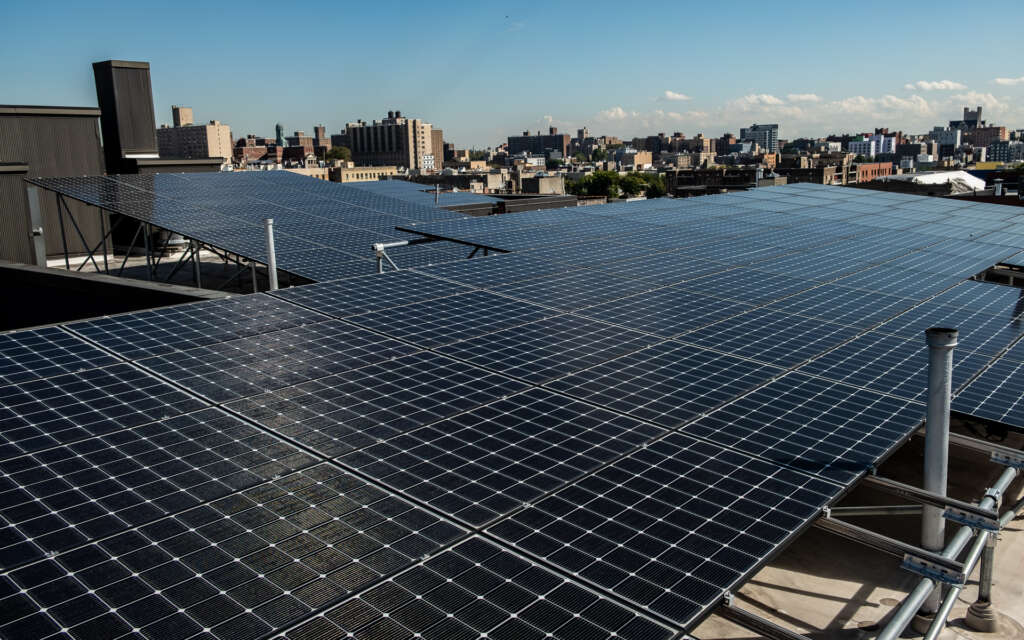
Clean energy advocates are pushing for a bill in Albany that would make it cheaper for affordable housing developers and nonprofits to install solar panels on their buildings—helping them save on surging energy bills while cutting pollution, supporters say.
Since 2008, New York City building owners have been able to take advantage of an incentive program that covers 30 percent of the costs of installing a solar energy system, issued annually over four years in the form of an abatement on their property tax bill.
But affordable housing providers, including religious organizations and nonprofits, can’t use the benefit since they’re often already exempt from property taxes or pay reduced ones, advocates say. Solar installations are pricey, and access to the abatement can cut the upfront costs by tens of thousands of dollars, what can be “the difference between these projects penciling out or not,” according to Graham Van Korff, policy and program manager at the nonprofit Solar One.
He and other advocates are championing a bill in the State Legislature that would expand the city’s Solar Electric Generating System abatement, known as SEGS, to these affordable buildings by giving owners direct payments for solar projects, commensurate with what the tax break would cover.
“It makes sure that every building in New York City basically becomes eligible for a version of the solar tax abatement, and that’s bringing parity,” the bill’s sponsor, Assemblymember Robert Carroll, who represents a Brooklyn district spanning Windsor Terrace to Prospect Heights, said at a press conference in April.
It would help more owners comply with the city’s Local Law 97, which requires they lower their properties’ greenhouse gas emissions to met a set of increasingly strict benchmarks over the next several years, or face penalties.
Buildings produce over two-thirds of New York City’s pollution, and solar is part of the city’s strategy for meeting its goal of carbon neutrality by 2050. It currently accounts for just 0.7 percent of the city’s energy grid, which is the “dirtiest” in the state, according to the NYC Comptroller’s Office. The city aims to install at least 1,000 megawatts of solar by 2030, up from the current 660 MW.
“We need to go after every place that we can to solve the climate crisis and to reduce carbon, and if we are shutting out nonprofits and houses of worship from renewable credits, we’re leaving a lot on the table,” Carroll said.
His proposal comes after the Trump administration last year gutted solar incentives for homeowners, and as New York Gov. Kathy Hochul looks to weaken the state’s own ambitious climate targets under the 2019 Climate Leadership and Community Protection Act, which she’s deemed unrealistic.

“We’ve had a lot of conversations about meeting the goals of the CLCPA,” Carroll said. “This is one of the ways that we can move in that direction.”
While the state authorizes SEGS, the city pays for it, and allowing tax-exempt nonprofits to access the perk via direct payments is expected to run just over $1 million for the first year and $5 million in year five, the bill’s supporters say—a not insignificant cost as Mayor Zohran Mamdani looks to plug a multi-billion dollar budget gap.
But supporters say it would also help tackle another problem on the mayor’s list: growing financial and physical distress in the city’s affordable housing stock. Operating costs for these buildings jumped 40 percent since 2017, one recent analysis found, prompting some owners to put off repairs. The price of insurance alone has more than tripled during that time, according to the mayor’s office, which unveiled its own public option for building owners last week as a cheaper alternative.
Rising costs are hitting the city’s Housing Development Fund Corporation cooperatives particularly hard, according to Caleb Weil of the housing advocacy nonprofit UHAB.
HDFCs are affordable co-ops controlled by tenant owners or shareholders, and are predominately concentrated in neighborhoods in upper Manhattan or the South Bronx.
“This is a community that really stands to benefit most from rooftop solar panels, which can provide protection from rising energy costs and bring much needed financial stabilization,” Weil said.
Switching to solar can save buildings an estimated $168,000 on their energy costs over 25 years, the bill’s advocates say.
“Every dollar that isn’t paid to private utilities is a dollar that can be reinvested back into the building,” Van Korff said.
To reach the editor, contact [email protected]
Want to republish this story? Find City Limits’ reprint policy here.
1 Comment