


Share This Article
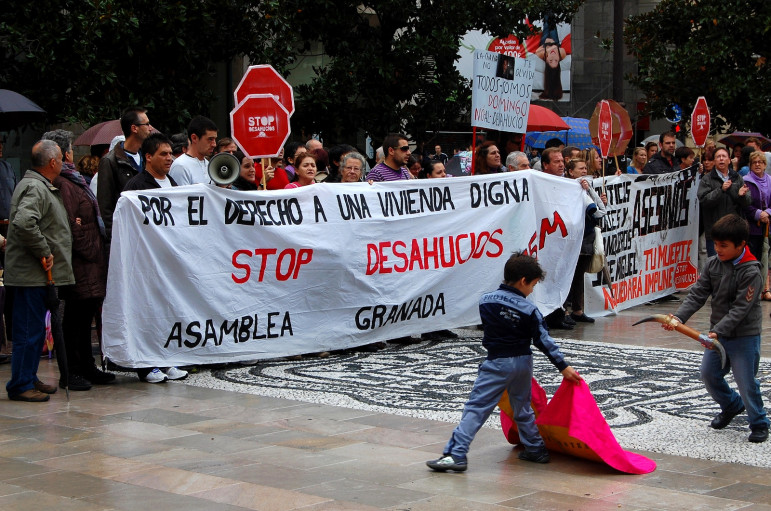
The foreclosure crisis that ran roughshod over U.S. homeowners from 2008-2012 has found its way to Europe. Blackstone Group, the international conglomerate that has purchased large portfolios of foreclosed homes and condominiums from the U.S. government and banks, is now swooping into the struggling housing market in Spain.
Blackstone is currently in talks with Catalunya Caixa Bank to purchase their portfolio of mortgages. Activists and community based organizations in Spain have made comparisons to the takeover of the Countrywide portfolio by Bank of America during the U.S. crisis. Americans saw an increased number of foreclosures and evictions by Bank of America once they acquired the Countrywide debts, and the bank eventually paid millions in fines as a result of the takeover and the resulting effect on homeowners who endured foreclosures and evictions.
In recent years Blackstone has satisfied its housing thirst by targeting rental housing in New York City, Chicago, San Francisco among other U.S. Cities. Now the firm has set its sights on single family and rental housing abroad.
Movements in Spain, such as the Platform of People Affected by Mortgages (PAH) have been very vocal in their opposition of Blackstone’s possible purchase of the Catalunya Bank mortgages and have traveled all the way to New York City to stage protests. On February 11th PAH called for an afternoon of global solidarity protesting In New York City and San Francisco where Blackstone offices are located to coincide with protests taking place in Barcelona.
The call to action in New York City was basically unanswered by housing activists and community based organizations, many of whom are engaged in similar struggles against Blackstone and other international corporations.
As far back as 2011 the Occupy Movement had Blackstone in its sights as a multi-national target. In August 2011, angry U.S.-based housing movements called out the U.S. government for issuing a Request for Proposals on 250,000 foreclosed and distressed properties it owned. Blackstone, realizing this was a huge opportunity, gobbled up those parcels to bolster its Real Estate Investment Trust (REIT) portfolio.
But lately it seems as though the city’s housing crisis is seen as only a local problem—or at least a problem with a local solution: Mayor de Blasio’s housing plan.
Trouble is, at its core, the mayor’s plan is flawed because it continues the same model of the prior administration: relying on a combination of public subsidies and exorbitant market-rate rents to allure developers and cross-subsidize their creation of income-targeted units. But any model like that only saturates New York City with market-rate housing while the true housing need is among fixed- or low-income residents. New York City needs housing for families with annual median income of $25,000 or less.
Yes, we need real rent reform, but we need more. We need job-training programs that target families and single adults who reside in shelters and that lead to sustainable wage jobs. We need to reinvest in public housing, which traditionally has served as a social safety net for low-income families. That means the mayor has to advocate for more funding on the city’s behalf in Albany and Washington while refusing to take no as an answer. Finally the city reeds to revisit the 80/20 model of affordable housing and seriously consider at minimum a 50/50 model.
Maybe the grassroots community in New York City needs to take notice of real progressive governments rising to power in Europe. The PAH was certainly inspired by the rise of the Podemos party in Spain and Greece has been offered a real vision of change and hope with the election of the Syriza government. While de Blasio’s Tale of Two Cities sounded as though he was representing the grassroots movement in New York City, the actions of the administration with respect to housing policy suggest it’s business-as-usual at Gracie Mansion.
Does New York City really believe de Blasio’s plan is the answer to the housing problem? It can’t be the answer when there are families paying as much as 70 percent of their incomes for rent. Or maybe housing movements in New York City suffer from the same exceptionalism they so often accuse the government of possessing. Could it be organizations that rely on grants to resource their work are afraid of losing that funding?
I believe that until we answer the global call for solidarity, and exercise our right of self-determination, we will never build the power we need to make the changes we want to see. In the coming weeks PAH will put out another call to action for global solidarity.
Hopefully the New York City housing movement will answer. Miloon Kothari, the first UN Special Rapporteur on the Right to Adequate Housing, said to me two years ago, “the powers oppressing people around the world are global in nature, the resistance has to be global in nature.” New York City and the U.S. housing movement must step up its game.
 Rob Robinson is a member of the Leadership Committee of the Take Back the Land Movement and a staff volunteer at the National Economic and Social Rights Initiative (NESRI). After losing his job in 2001, he spent two years homeless on the streets of Miami and ten months in a New York City shelter. He eventually overcame homelessness and has been in the housing movement based in New York City since 2007. In the fall of 2009, Rob was chosen to be New York City chairperson for the first ever official mission of a UN Special Rapporteur on the Right to Adequate Housing.
8 Comments
Zee
No, NYC does not need housing for those families making 25,000 or less. Folks making that small amount of money should leave and go to live in much less expensive parts of the country.
Mari
Dear Zee, you are living in precarious times. Unless you are one of the members of the numerically extremely small super rich, you may find that what you expect of those making under $25,000 may be forced on you as well. The over 4 million foreclosures that have occurred in recent years show how vulnerable people who make far above $25,000 are.
Mob Squad NYC
This is an important article.
Civilization is under attack in multiple ways. Through state engineered austerity programs our needs are no longer being met–housing, food, medical care, education, social services, are understood not as vital resources serving collective need, but as products to be consumed within a self-regulating marketplace.
The post democratic world is fueled by economic hyper-capitalism, austerity and neoliberalism, mass propaganda and manipulations of the press, corporate corruption, and widespread human rights abuses of the sort that prompted the #BlackLivesMatter and prison abolition movements. Within higher education this economic restructuring has been carefully mapped by student unionists – https://ow.ly/KDPZH.
We are within the neoliberal, post democratic era of “emergency managers,” “too big to fail” and metered water. An era in which selected institutions take on the role of state-protected, highly disciplined, monopolies, and where bureaucrats who are deeply connected to these same monopoly corporations engineer the political process to serve the needs of their tightly interconnected corporate boards. Monsanto, Blackwater, Time Warner, InBev, De Beers, Google Inc, Bloomberg, Facebook, GE, Apple. This is the center of political gravity. The beast must be fed. On the face of it, the US political process and claims to democracy are marketing scams. Elections are tightly structured to support the status quo political monopoly of corporate rule over Washington, and thus the neoliberal restructuring process keeps reproducing, digging ever deeper into civil society, eroding any notion of the common good, the commons, interconnectedness, democracy, kindness, or human decency.
The poison of liberalism is what is holding back social progress at this point. We are silo-ed and silenced. Muted and confused by the moderate left.
Any attempt at serious social justice, or even justice, is met by a liberal voice or institution that refuses to “rock the boat” lest we upset “the funders” or “our partners” who are frequently local non-profits funded by the big philanthropies Ford, Rockefeller, Bloomburg, Knight, Mellon, Roosevelt, and consortiums of these same interests, such as ArtPlace America (https://www.artplaceamerica.org/about), which has effectively privatized the National Endowment for the arts, and now aids waves of gentrification across the country.
This has been clearly described by Joanne Barkan “Plutocrats at Work: How Big Philanthropy Undermines Democracy https://dissentmagazine.org/article/plutocrats-at-work-how-big-philanthropy-undermines-democracy and by Arundhati Roy in her important piece: “The NGO-ization of resistance” https://massalijn.nl/new/the-ngo-ization-of-resistance, written in response to the top-down, corporate friendly: “Peoples’ Climate March.” A march that left many long-time activists feeling as though we had been tricked into participating in a big photo-op. One that was designed behind the scenes by a small group of white men with stipends, which is exactly what it was.
Barkan and Roy’s pieces are a part of a growing body of literature no the corrupting influence democratic party and liberal 1%-er money is having on grassroots social justice movements. The issue is not that money is bad, but the mix of social justice work in particular and the fundamentally pro-capitalist, pro-status quo bend of the big foundations, is toxic and socially destabilizing. The models of oppression we need to overcome are the very same ones reproduced by big philanthropy: top-down, corporate friendly, authoritarian, oftentimes racist, and non-democratic.
The results: Within the population we have fragmentation, confusion, shock (referencing: the “shock-doctrine”), fear, and a defensive individualism. And within the mix an ascendant and fiercely individualistic libertarianism along with far right wing religious extremism, both creeping in.
Within liberal institutions such as non profits and schools, there is fear and confusion, and an inability to “connect the dots” to see the larger structures at play in society, an inability to correctly strategize for long term planning or to see beyond the limits of legislative schedules, exclusionary ivory tower attitudes, and funding cycles.
The models to move forward are clearly demonstrated by movements such as the Chilean https://en.wikipedia.org/wiki/2011%E2%80%9313_Chilean_student_protests and the Quebec student movements of 2015: https://printemps2015.org/en/introduction and 2012: https://www.studentstrike.net/howwewon/wp-content/pdf-version/quebecstudentstrike.pdf, as well as movements against austerity in countries such as Spain and Greece, which have been politically and organizationally successful, and whose methods are known, and not impossible to emulate. Although they need to be re-structured to account for our own cultural tendencies (the demand for instant results, aggression), not to mention the pernicious “isms” that afflict and haunt the left as much as the right.
In addition to Mr. Robinson’s clear and important call for international solidarity other great thinkers and organizers such as Angela Davis are calling for trans-national resistance to corporate rule, neoliberalism, and austerity. What’s missing are the organizational models and cultures that will allow these cross boarder calls to extend into more permanent structures. And again, from movements around the world we have frameworks, strategies and histories of political escalation that work: peoples’ / neighborhood / & student assemblies, direct democracy and action, and most importantly–combative unions. These formations are grassroots, independent, robust, proven to work in hostile environments, and able to scale up to meet the needs of movement work and civil society.
The unfortunate alternative is also clear: continued misery and abuse, escalating human rights crimes, dangerous inequality, and eventually–social chaos.
heather white
Excellent analysis – thank you!
Lisa, Berlin
Great article! Blackstone is well known in Berlin, where they cashed in in the last years selling thousends of units. Their profits in Berlin are directly linked to the (housing) crisis in Spain: After the financial crisis Berlin’s long modest rental market became the save haven for investment seeking global capital fostering massive rent increases and giving investors like Blackstone the opportunity for their speculative practices.
To face these kind of global actors tenant movements all over the world have to rethink their organizing and actions.
Another example of global capital active in Germany and the US is the Czech based fonds “EPG Global Properts Invest”. Together with McKafka Development Group they purchased 62 luxury condos at the hight of the real estate crisis in Florida only to sell them off individually to European and South African investors a few years later with a profit margin of 30%. In Berlin they have know bought a development site in one of the cities most gentrifying neighborhoods for 36€ million. Political negotioations over the deal have failed beforehand. This shows us: We have to employ more radical forms of action, like occupation and appropriation. It is time to send a clear signal to investors like Blackstone and EPG Global Property Invest: Cities for people, not for profit.
The Blog on the actions around EPG Global Property Invest (in German, unfortunately): https://stadtvonunten.de/
Howard Hecht
80/20 or around this percentage breakout (let’s not quibble) is an excellent program approach. Yes, it will take longer but making it mandatory combined with 100% affordable developments it will make progress. It encourages larger developments which produce more sustainable affordable, as well as market rate housing. It strengthens the economic base of the communities while providing all with economically sustainable housing. As more and larger 80/20 developments are planned, announcements are made that they will contain 150 or 200+ affordable units each. These would be large affordable developments in their own right. Where would the equity and operating income come from to build and maintain such developments. The tax credit and bonding capacity of the city and state are not infinite. Rental subsidies are very limited. The current approach is working…
Anon resident
Let’s address some of the churches who have empty lots just sitting and they are doing nothing with them or the housing on the lot has rotted away.
Al Macinnis Jersey
one Increase The very first thing At the moment