


Share This Article
Tenants organizing across 31 Manhattan buildings in foreclosure are the latest to see support from Mamdani’s newly reinvigorated Mayor’s Office to Protect Tenants.
Since January, the newly reinvigorated Mayor’s Office to Protect Tenants has made it its business to support tenant unions across the city.
Now, city-employed tenant leaders are working with two new tenant unions in Hell’s Kitchen, where residents are asking for help in securing repairs and stewarding their troubled rent stabilized properties through a potential future sale.
The majority of tenants in the impacted buildings have come out in support of the union effort—a milestone, organizers say, that helps them get the attention of both their landlords and the city—and could represent another chance for the Mamdani administration to steer distressed affordable housing into the hands of tenants’ preferred buyer.
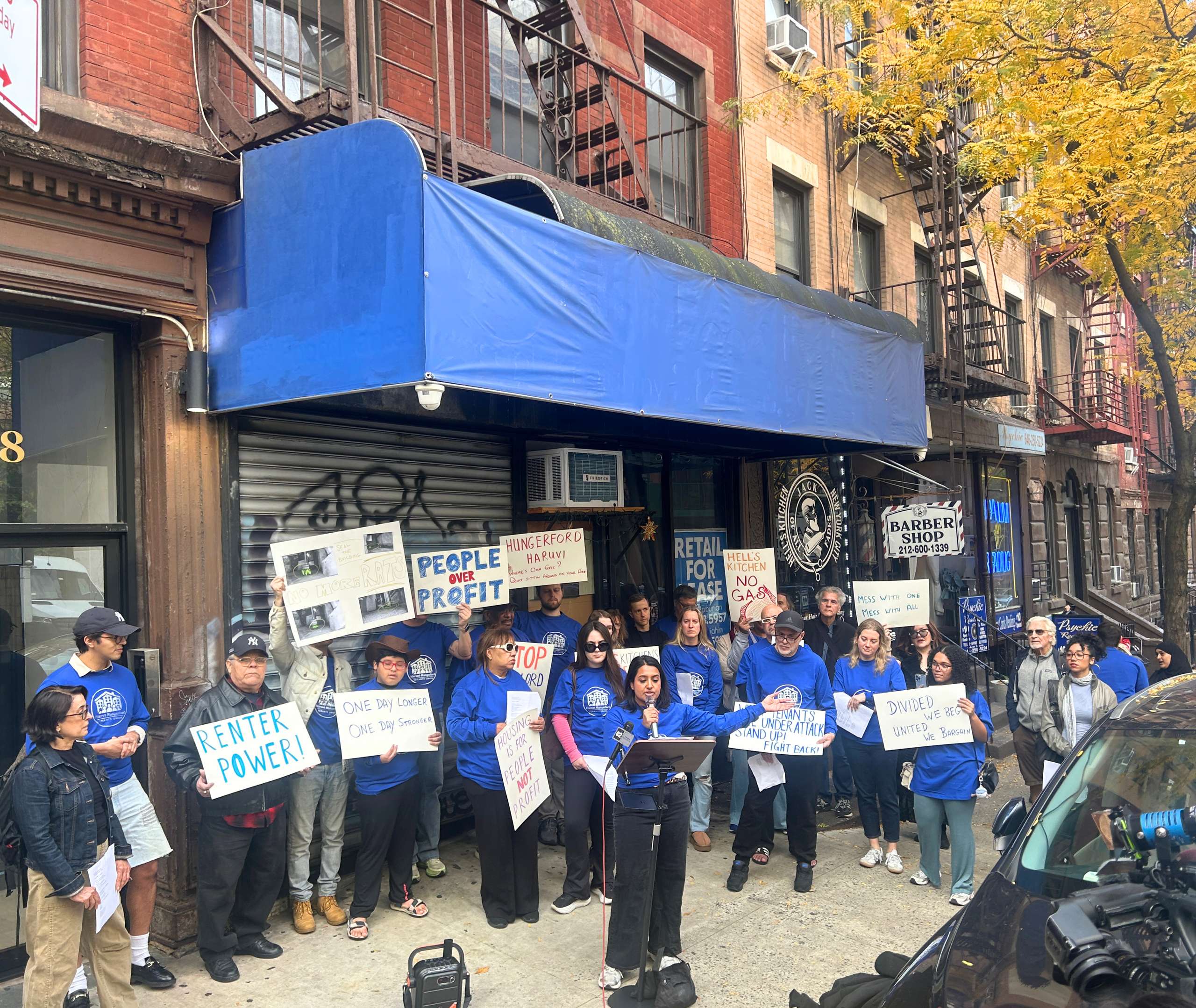
One of the unions represents tenants in 31 buildings owned by Arthur Haruvi and Peter Hungerford, which launched on Saturday, where tenants stood with city leaders outside 408 W. 56th St., where they say cooking gas has been out for 722 days. The residents are demanding repairs and a seat at the table when it comes to the future of their dilapidated buildings, now in foreclosure and bankruptcy.
“The two years without cooking gas has had a big toll. My family, and especially myself, like to cook during the holidays. We can’t cook Thanksgiving and Christmas meals on a hot plate,” said Luis Pelaez, who has lived in the building for 34 years.
There are 357 open housing code violations across the 478 units facing foreclosure, according to analysis by Housing Conservation Coordinators.
Tenants say that Peter Hungerford has responded to their request to meet, and they hope to go to the bargaining table in the coming weeks. Hungerford did not respond to City Limits’ requests for comment.
On Saturday, tenants of landlord David Ohebshalom will launch their own tenant union for nine buildings (including both rent stabilized and market rate units) on West 47th Street, alongside the Mayor’s Office to Protect Tenants head Cea Weaver.
Ohebshalom’s brother Daniel has made headlines before: he did jail time in 2024 for failing to comply with court orders to repair hazardous conditions at two buildings in Washington Heights.
Can tenants influence a sale?
Third time’s the charm?
Since January, the newly reinvigorated Mayor’s Office to Protect Tenants has tried to influence the sale of two major portfolios of rent stabilized housing in New York. But each time, efforts to steer the buildings to preferred buyers have stumbled.
Early this year, officials intervened too late to stop the bankruptcy sale of 5,000 units from prior owner Pinnacle to private landlord Summit. And in July, housing officials backed the bid of preservation group Spatial Equity to buy 850 units in East Harlem, only to see their offers turned down and the portfolio go up for foreclosure auction this week.

without cooking gas. (Patrick Spauster/City Limits)
Tenants in the Haruvi-Hungerford buildings say that their immediate concerns are securing repairs and maintenance, including restoring cooking gas and addressing pests. Some of the buildings are also included in a class action suit by Housing Rights Initiative against Peter Hungerford’s PH Realty Capital, which accuses the company of overcharging tenants in 18 buildings by $15 million.
But residents know they face a precarious position with their buildings in foreclosure. “If our buildings go up for sale we need a say in who buys them and the terms of that purchase,” said Joseph Di Salle, a resident at 450 57th St.
Tenants and their allies in city government have limited control over what ends up happening to their buildings in such scenarios. But some have credited the work of unions with pushing new landlords into concessions, like when Summit real estate forgave back rent for former Pinnacle tenants shortly after taking over.
The mayor’s housing plan includes some measures that can help tenants assert more control over their buildings when they go up for sale. Tuesday, he signed the Community Opportunity to Purchase Act into law, a measure that would give some city-approved buyers first dibs on distressed rental properties before they hit the wider market.
Those attempts to influence ownership, and the city’s overt support for tenant unions, has rubbed some property owners the wrong way, saying it “vilifies” them. And at least one developer that the administration championed recently, in the sale of three debt-riddled rent stabilized Crown Heights buildings, has a less than stellar maintenance record of its own, The City Reporter reported Tuesday.
But others see a clear role for City Hall to play.
With the Hell’s Kitchen buildings, Charlie Dulik of the Mayor’s Office to Protect Tenants said that the city could coordinate code enforcement, come to the bargaining table with tenants, or liaise with the landlord for the Haruvi-Hungerford tenant union.
The tenants have not, as of yet, asked for support in steering their homes to a preferred buyer. If they asked, “we would absolutely talk about it and see what we can do,” said Dulik.
To get traction, get the majority of tenants on board
The Hungerford-Haruvi buildings fit the profile for the kind of properties most likely to get City Hall’s attention. The portfolio is vast, mostly rent stabilized, and connected to a former member of the city’s worst landlord list. It also has a tenants union.
And its members on Saturday, wearing freshly pressed royal blue T-shirts, said that a majority of tenants across 10 Hell’s Kitchen buildings in the Haruvi-Hungerford portfolio had signed on with the union.
Ten blocks south, the West 47th St. Tenants Union also declared that it has the majority support of tenants in nine buildings between 8th and 9th avenues, and are calling on their landlord Ohebshalom and his management company to address rat, mouse, and pest infestations, as well as ongoing maintenance needs.
The 50 percent threshold—getting at least half of a building or buildings’ tenants on board with the union—is key, tenant leaders said, indicating that they will have significant bargaining power.
“Supporting tenant unions and majority tenant unions is incredibly important,” said Dulik, wearing a freshly screenprinted Mayor’s Office to Protect Tenants jacket.
Getting to a majority of tenants has become standard practice in the field, advocates say, in part to a growing national tenant movement. The Mamdani administration has been exploring ways to give tenant unions official legal status and recognition and allow them to sue, similar to how the National Labor Relations Board recognizes labor unions.
“There’s going to be more of an emphasis on majority unions for sure, but there’s also going to be an emphasis on portfolio-wide organizing because that’s when you can make the most changes,” said K Agbebiyi, director of communications at Housing Justice for All.
Hell’s Kitchen is one of the city’s most expensive neighborhoods, with smaller walk up buildings nestled between luxury towers.
“Neighborhood tenant unions and community-based organizations are anchors for neighborhood stability,” said Alejandro Coriat, director of borough organizing for Manhattan Borough President Brad Hoylman-Sigal. “It is what kept Hell’s Kitchen, some parts of Chelsea, and some parts of the Upper West Side affordable for working class people for a very long time.”
To reach the reporter behind this story, contact [email protected]. To reach the editor, contact [email protected]
Want to republish this story? Find City Limits’ reprint policy here.