


Share This Article
The city is earmarking an extra $25 million to hire 300 additional outreach workers and open more low-barrier shelter beds, officials announced Friday. It comes after a brutal freeze killed 18 New Yorkers last winter.
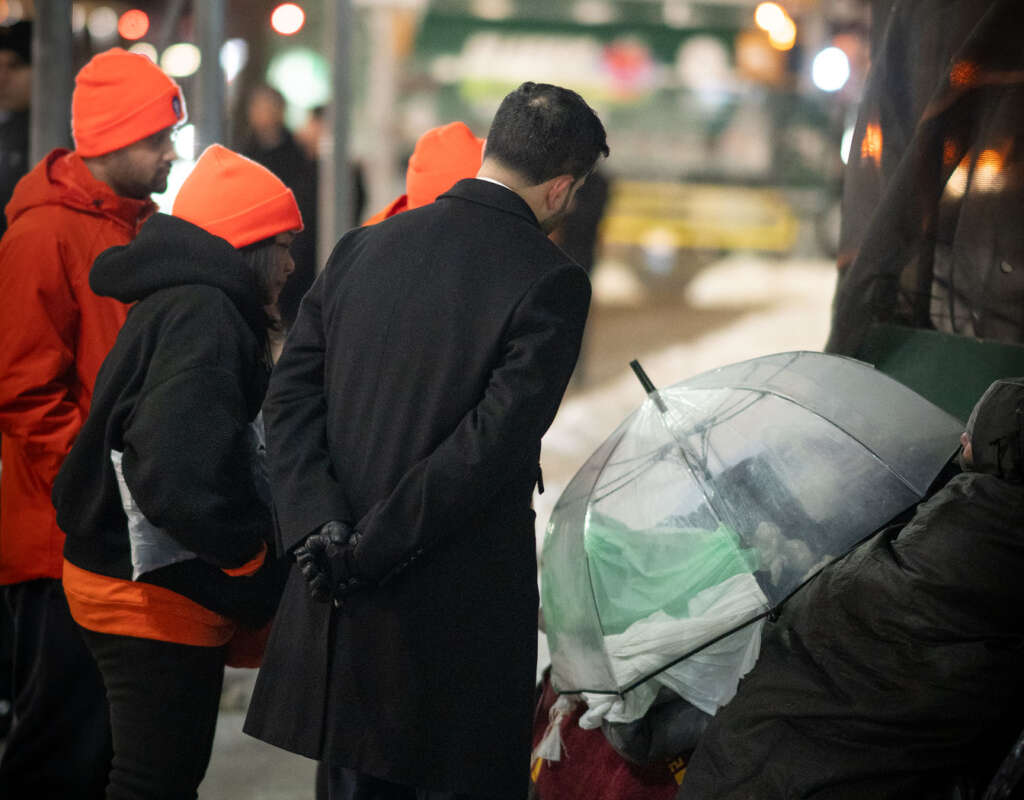
The city will spend an extra $25 million to expand its homeless outreach efforts when temperatures drop this winter—hoping to avoid a repeat of last year, when a brutal stretch of historically cold weather killed 18 New Yorkers, many of them unhoused.
Mayor Zohran Mamdani announced the additional funding at a press conference on Monday, part of a sweeping package of winter preparedness reforms that will also include “supercharged” plows and new snow blowers.
The $25 million will go to beefing up the Department of Homeless Services’ “Code Blue” operations, which kick in when temperatures dip below 32 degrees Fahrenheit overnight.
It’ll pay for 300 additional outreach workers, including nurses, to canvas city streets and implore people to come indoors. It will also open more public warming facilities, including heated buses and vans, and to creating another 800 “low barrier” shelter beds—sites with fewer entry requirements and less stringent rules than typical city shelters.
Those beds will be in single- and double-occupancy rooms, officials said, offering greater privacy than crowded—and sometimes, dangerous—group facilities that many street homeless New Yorkers are reluctant to enter.
“When we speak to homeless New Yorkers, we will hear that if only there was a low barrier single room bed, they would then be willing to go,” the mayor said.
Mamdani was newly inaugurated when last winter’s emergency cold conditions hit—what officials say included the city’s first blizzard in a decade as well nine consecutive days of below-freezing temperatures.

The cold killed at least 18 people, including several unhoused residents.
“I wasn’t here in the heart of last winter, but I’ve reviewed it, and I know how it went, and I learned a lot from it,” said Department of Social Services Commissioner Erin Dalton, who oversees the Department of Homeless Services (DHS). Mamdani appointed her to lead the agency in February.
Dalton said DHS will be making key changes to its cold weather response this year, including having its street outreach teams adopt a “broad geographic canvassing approach.”
This breaks from previous winters in which homeless outreach teams focused their efforts on a list of about 350 known street homeless New Yorkers, visiting their usual spots and urging them to take shelter. On most nights, the city was only able to locate about 15 percent of the people on that list, Dalton said.
She added that workers are already engaging with those folks before very cold weather sets in, but that “an approach built around a vulnerable list leaves way too many people in the street that aren’t known to us, and only covers a small portion of people.”
Instead, Dalton says, outreach teams will “walk the streets, encampments, parks, and subway steps where we know the vast majority of people experiencing homelessness stay,” and “engage every vulnerable person along the routes.”
The commissioner said DHS tested this broader canvassing approach over the summer during heat waves, and were able to reach far more people—”more than 20 times as many as on a given day” compared to the summer before.
While homeless advocates applauded the additional resources, they said many of the changes are long overdue.
“These are smart responses that will save lives. But these are also well-known action steps that have been called for for years,” VOCAL-NY, a grassroots group that organizes low-income and systems impacted New Yorkers, said in a statement Monday.
VOCAL leaders called on the city to invest more in permanent solutions to getting New Yorkers off the streets, like with additional city-funded rental vouchers and supportive affordable housing.
“That’s kind of the the ideal. It’s moving people into permanent housing,” Charles King, the CEO of the homeless nonprofit Housing Works, told City Limits last week, when the organization held a funeral mass for nine of the unhoused New Yorkers who died of hypothermia in last winter’s extreme cold.
“At the end of the day, giving a person a decent place to live is what all of us need.”
To reach the editor, contact [email protected]
Want to republish this story? Find City Limits’ reprint policy here.