


Share This Article
The remains of the nine unhoused people, who died of hypothermia on the city’s streets, were initially slated for mass graves on Hart Island—until a group of fellow New Yorkers stepped in.
Last winter, a brutal stretch of cold weather and lingering snowstorms killed at least 18 people in New York City, including several who were homeless and on the street at the time of their deaths.
Months later, nine of those unhoused New Yorkers’ remains had yet to be claimed by friends or family, despite what one advocate described as “diligent searches” on the part of the medical examiner’s office to locate next of kin. Their bodies were headed for Hart Island, the city’s desolate potter’s field off the shore of City Island in the Bronx, which for more than a century has served as the final resting place for those without someone to plan or pay for their burial.
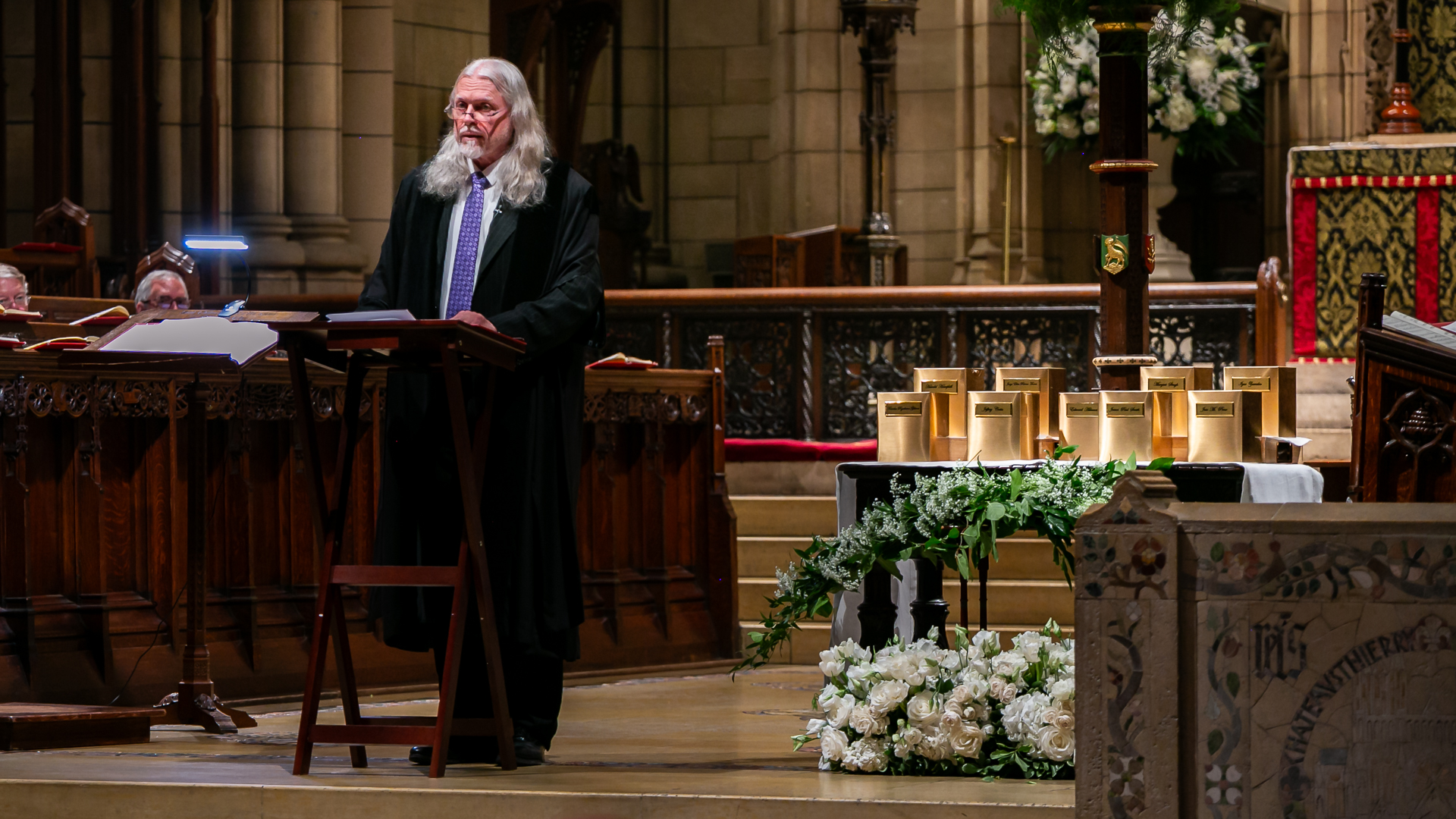
Instead, after several fellow New Yorkers stepped in, the nine late residents were honored with a funeral mass Monday night at Saint Thomas Church Fifth Avenue, where their ashes—contained in square golden urns, their names inscribed on the front—were interred in the cathedral’s columbarium.
“We believe that those who have been homeless deserve dignity in death, even if they did not receive it in their lives,” Charles King, CEO of the homeless services nonprofit Housing Works, said during the service, where the robed church choir sang “Amazing Grace” and other hymns set to booming organ music.

“We want our fellow New Yorkers to appreciate the cost of our collective decision to throw away human lives, as evidenced by our lack of meaningful shelter and care for the least among us,” King said.
Few details are known about the nine people laid to rest, organizers said. All of them died from hypothermia, found in different parts of the freezing city—one in the doorway of a building in the East Village, another along the Van Wyck Expressway in Queens—between November 2025 and February 2026. They ranged in age from 38 to 74, and came from South Carolina, Puerto Rico, Russia, and India; two were born in the city.
Their names were James Paul Smith, Manjeet Singh, Harold Hemphill, Tomeka Ryeshera Gibson, Jorge Elias Rivera Torres, Jeffrey Costa, Edward “Eduardo” Adames, Jose M. “Joseph” Pena, and Igor Zapevalov.
“We know little of these nine neighbors, but we do know this: they are beloved,” Rev. Mark Schultz of Saint Thomas Church said during the service.
The ceremony and interment were arranged by Community Burial Project, a new initiative founded by artist Rhonda Roland Shearer to provide memorials for New Yorkers experiencing street homelessness at the time of their deaths.
Shearer, who spent the months after 9/11 distributing supplies to first responders at Ground Zero, said she was struck by the ceremonial process for handling recovered remains there, which she described as “dignified and very emotionally present.”
She’d previously partnered with Housing Works to raise memorial funds for unhoused New Yorkers who died during the COVID-19 pandemic. She was distressed, she said, at the prospect of those killed during last winter’s deadly cold being sent to Hart Island, where the dead are buried in mass graves.
“No one’s allowed to be there to pray,” she said of burials on the island, which for years were largely inaccessible to the public.
Shearer reached out to Housing Works, which connected with the city’s Human Resources Administration and Medical Examiner’s Office to make arrangements for any victims of the cold snap who went unclaimed. A local funeral home provided the funeral services and urns, and Saint Thomas’ offered the columbarium space. Additional expenses were covered by a donation from the author Amy Tan and her husband, Shearer said.
“The ability of community to just come together on this is the big message here,” she said. Going forward, the Community Burial Project will make similar arrangements for other street homeless New Yorkers at risk of being “forgotten,” she added.
“These nine, I believe, are not only being treated with dignity and getting the respect that all humans deserve, but I think they’re going to serve, in this case, the larger effort…to continue this,” Shearer said. “That will also add another layer of what meaning was conveyed by their lives.”
King, of Housing Works, said he and the organization have pushed for years for the city to cease its use of Hart Island for burials, and to come up with a “dignified way to deal with people who don’t have anyone to claim their remains.”
“They bury people in pine boxes, often five deep in these big anonymous holes,” he said.
The public memorial service, he explained, was also a way to “to make the public aware of the homeless people we walk around all the time,” and the need to treat them with respect, both during life and after it.
He called for the city to invest in more drop-in centers to offer “humane and comfortable spaces” for unhoused people, with fewer restrictions and better conditions than the often crowded—and sometimes dangerous—city shelters that street homeless New Yorkers are reluctant to enter.
“The truth of the matter is, we tend to look at homeless people in a very one-dimensional way, forgetting that they have their own hopes, their own dreams, their own aspirations,” King said.
To reach the editor, contact [email protected]
Want to republish this story? Find City Limits’ reprint policy here.