


Share This Article
“New York City, especially, has a lot of laws that regulate language access,” said Olivia Nuñez, NYC Campaign Finance Board community engagement director. “All New Yorkers have the right to vote and to get a ballot in their language.”
This story was produced in collaboration with Factchequeado.
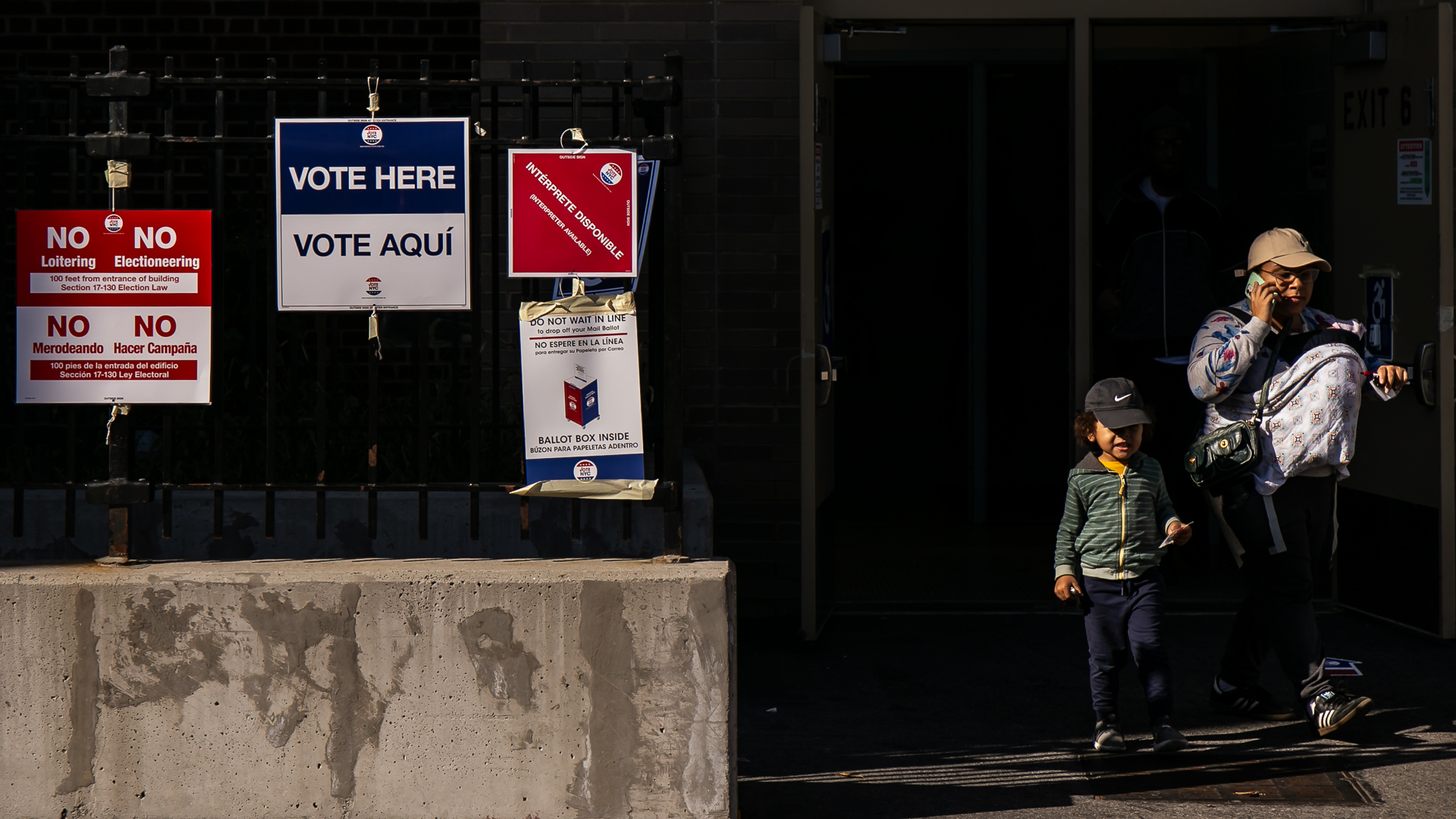
New York City’s linguistic diversity is vast, with residents speaking just over 700 languages.
Language access in New York City elections is governed by a multi-layered framework of federal, state, and city laws, covering different segments of the non-English-speaking electorate. These laws cover a little more than a dozen languages—the most widely spoken ones.
“New York City, especially, has a lot of laws that regulate language access,” Olivia Nuñez, NYC Campaign Finance Board community engagement director, explained. “We actually have more laws in place of protection than even at the federal level does.”
In New York State, about 5.96 million people aged 5 and over spoke a language other than English at home in 2024, according to Census data. A New York City Campaign Finance Board report published that same year found that 16.4 percent of New York City citizens of voting age had limited English proficiency. In boroughs like Queens and the Bronx, this percentage is even higher, accounting for 20.7 and 19.5 percent of voting-age residents, respectively.
RELATED READING: In New York Governor’s Race, What Are Candidates Doing to Reach Spanish-Speaking Voters?
Several local agencies that provide services to non-English-speaking voters have trained and recruited hundreds of interpreters, who have been deployed to the city’s early voting sites (early voting kicked off on Saturday, and will run through Sunday, Nov. 1). A second, slightly larger team of interpreters is preparing to do the same on Election Day on Tuesday.
City Limits put together this guide to help New York voters understand their rights at the polls regarding language access.

The Voting Rights Act
In 1975, Congress amended the Voting Rights Act of 1965, adding protections to remove barriers that prevented people with limited English proficiency from voting in elections.
The amendment ordered regions with significant numbers of people who speak a language other than English at home to provide them with language assistance at the polls.
Under these provisions, eight New York counties—including Brooklyn, Manhattan, Queens and the Bronx—must provide interpretation services to voters in certain languages, including Spanish, at select poll sites.
The New York Voting Rights Act
New York State also has its own language access protections. In 2022, Gov. Kathy Hochul signed the John. R. Lewis Voting Rights Act of New York, lowering the population thresholds (compared to federal rules) that require localities to offer multilingual voting assistance.
New York’s “2 Percent or 300-Individual Rule” requires local governments to translate election materials into languages other than English when this percentage of the population has limited English proficiency (LEP) skills, based on data from the American Community Survey. There’s additional criteria mandating translations when there are more than 4,000 LEP-eligible voters in a specific political subdivision.
Under the law, translated materials—like voter registration forms, notices, instructions and ballots themselves—must be of “equal quality” to English versions.
Additionally, when the language spoken by a “minority group” has been historically oral or unwritten, the state of New York is required to provide oral interpreters for translation.
NYC’s language access laws
New York City has also enacted its own laws to address its immense linguistic diversity, and complement federal and state protections.
The New York City Board of Elections (BOE)—which creates the city’s ballots, runs polling places, and counts the votes—provides translators at certain poll sites in the following languages, based on the neighborhood’s linguistic needs:
- Manhattan: Spanish and Chinese
- Brooklyn: Spanish, Chinese, Korean, Bengali, and Urdu
- Queens: Spanish, Chinese, Korean, Bengali, Tagalog, Hindi, and Punjabi
- The Bronx: Spanish
- Staten Island: Spanish and Chinese
Around 60 percent of BOE poll sites get language help for a covered language under either the federal or state Voting Rights Act, Deputy Executive Director Vincent Ignizio explained. There are 2,000 interpreter positions to fill for a full election, Ignizio added.
The Campaign Finance Board (CFB), a nonpartisan city agency that administers the city’s campaign finance system and matching funds program, also conducts voter multilingual education, outreach, and engagement initiatives through NYC Votes.
Each year, the CFB publishes a Voter Analysis Report that looks at underrepresented areas of the city where people aren’t voting or taking part in elections, and designates these as “Priority Communities.” The board then builds strategies to engage these communities, which include voters under 30, naturalized foreign-born voters, voters with limited English proficiency (LEP), and voters with disabilities.
“CFB identified neighborhoods in the South Bronx, South Brooklyn, Northern Queens, and Central Queens as communities in need of targeted voter outreach because of the number of recently naturalized residents or residents that speak languages the CFB has not historically included in voter outreach,” explained CFB Assistant Press Secretary Jadel Munguia.
“These are areas that we see a lot of low voter turnout, and again, a high population of immigrants,” explained Lía Guzmán, a CFB neighborhood specialist for the Bronx, during a recent bilingual voter outreach workshop (in English and Spanish) in University Heights.
“We recognize that there are a lot of different barriers to voting, and we recognize that language is one of them, which is why we’ve done the work to make sure that our materials are available in 13 different languages, along with our website.”
CFB’s voter guides, which are mailed out across the city, are available in 13 languages: Arabic, Bengali, French, Haitian Creole, Hindi, Korean, Polish, Punjabi, Russian, Simplified Chinese, Spanish, Traditional Chinese, and Urdu.
“We really want to ensure that all New Yorkers have access to the information they need in the languages that they speak,” Nuñez said. “All New Yorkers have the right to vote and to get a ballot in their language.”
In 2018, New Yorkers voted yes to creating the NYC Civic Engagement Commission (CEC), designed to provide additional language interpretation for voters beginning in 2020.
CEC’s interpretation program was one of a small number of set responsibilities, and the language access requirement, by law, can’t duplicate what the BOE already does, requiring the CEC to focus on different languages and neighborhoods.
The Commission started providing interpretation services in 11 languages in neighborhoods with high concentrations of “citizens of voting age with limited English proficiency” or CVALEP, based on estimates from the American Community Survey, explained Dr. Sarah Sayeed, CEC’s chair.
In 2019, the BOE sued the city to block CEC translators, but the city ultimately won the case. “This was one not handed down,” recalled Murad Awawdeh, the president and CEO of the New York Immigration Coalition, who was involved in creating the Commission.
Later, the CEC expanded its services to 14 languages.
“The CEC created the Voter Language Assistance Program to ensure that anyone who speaks the … top 14 languages in New York City had the support that they needed when they got to a polling site, to have someone translate for them and help them understand their ballot better,” Awawdeh added.
Sayeed and Anila Cobo, director of the Voter Language Assistance Program, said they plan to operate at 100 unique polling places for the general election, and have a team of 240 interpreters ready.
You can find your polling site here. CEC’s poll sites map, which shows which locations offer translators, is available here.
If there’s no interpreter available at your poll site, you can be assisted by a “person of your choice”—as long as the person is not your employer, an agent of your employer, or an officer or agent of your union. The “voting helper” doesn’t have to be a U.S. citizen, a registered voter, or even an adult.
“If a ballot in their language isn’t available at their poll site, they can bring someone with them to support the translation,” Nuñez explained. “They really can bring anyone with them, and there are a lot of protections in place for New Yorkers to ensure that their voting rights are protected.”
Ignizio said that BOE maintains a reserve pool of poll workers and interpreters so they can deal with last-minute staffing issues. They also offer video interpretation. “Poll sites are equipped with a tablet that voters who need language assistance can use to connect with a remote interpreter, helping ensure that language assistance remains available even when an in-person interpreter is unavailable,” Ignizio added.
Unfortunately, there is no single public map or site that consolidates all BOE, CEC, federal, and state language access services for each polling place in New York.
If you need help voting and there’s no interpreter available, ask a poll site worker for assistance.
Voters who experience issues at the polls—like a poll worker saying they can’t bring their “person of choice” in to help them complete their ballots—can do the following:
- Call 311 and make a poll site complaint
- Call the Election Protection Hotline at 866-OUR-VOTE (866-687-8683). Assistance is also available in Spanish at 888-VE-Y-VOTA (888- 839-8682)
- Contact the New York Attorney General Office’s voter protection hotline: 866-390-2992
To reach the reporter behind this story, contact [email protected]. To reach the editor, contact [email protected]
Want to republish this story? Find City Limits’ reprint policy here.