


Share This Article
A “grassroots” homeowners group leading the charge against Local Law 97 has deep ties to a powerful real estate industry association, New York Focus reports.
This story originally appeared in New York Focus, a nonprofit news publication investigating power in New York. Sign up for their newsletter here.
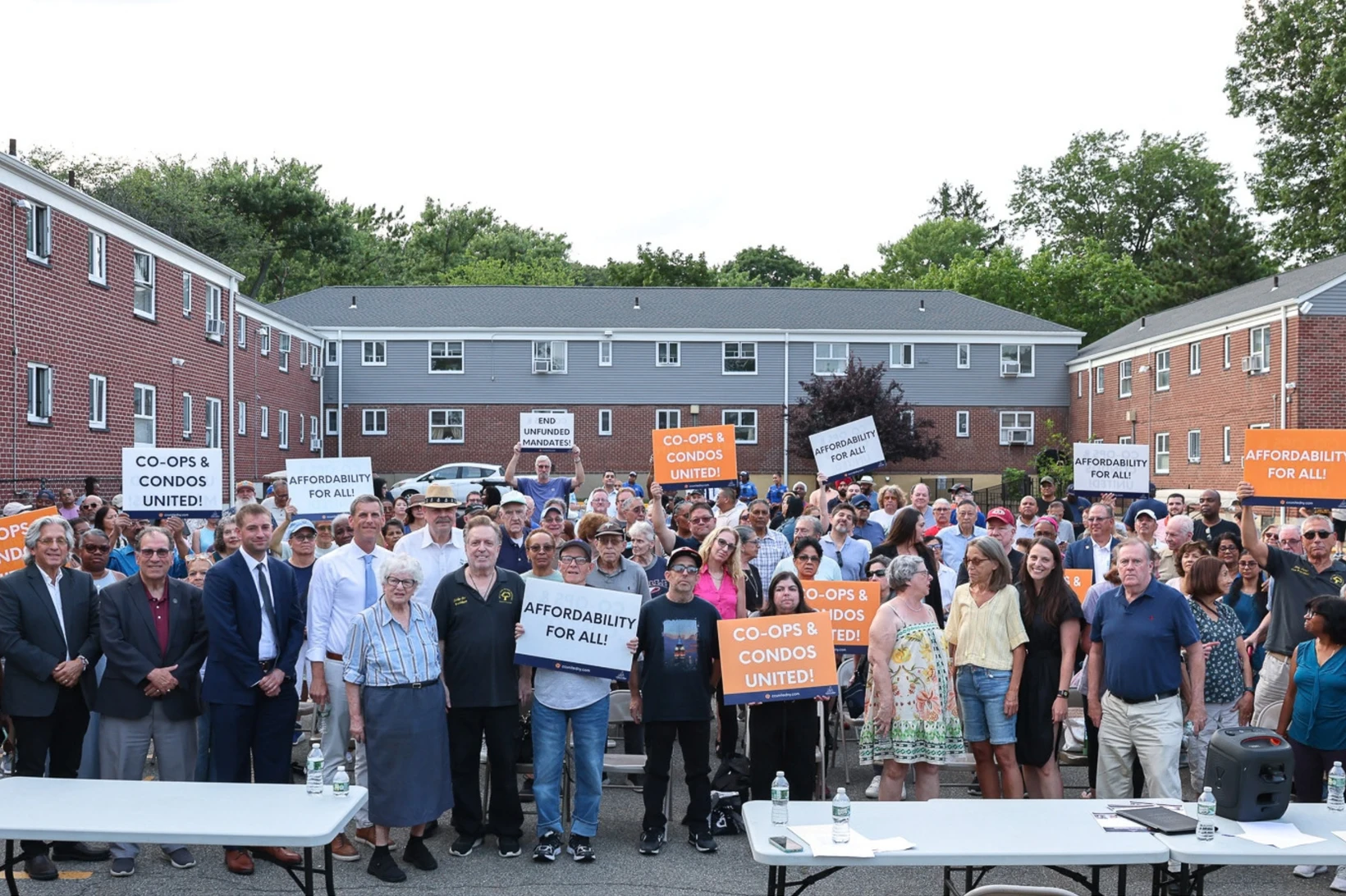
In March, the New York Real Estate Journal announced the formation of a new “grassroots advocacy group” representing the more than one million New York City residents who live in co-ops and condos. The group, Co-ops and Condos United, has focused much of its lobbying efforts on opposing Local Law 97, the 2019 city law requiring large buildings to limit greenhouse gas emissions. Within just a few months, the fledgling group’s rallies have attracted high-profile politicians, including Congressmember Tom Suozzi and a host of city and state lawmakers, and sympathetic media coverage in half a dozen publications.
But Co-ops and Condos United has deeper ties to the real estate industry than its grassroots branding suggests. The group is a rebranding of Homeowners for a Stronger New York, a prominent critic of Local Law 97. Until its renaming last fall, Homeowners for a Stronger New York received all its funding (over $750,000) from a lobbying group run by the Real Estate Board of New York, or REBNY, which represents some of the city’s largest developers.
The group changed its name last November. Its former president, Geoffrey Mazel, remains a leader in the rebranded organization, telling New York Focus he serves as CCU’s co-founder, executive member, and legal advisor.
In a phone interview, Mazel said that CCU receives funding from REBNY but also has “a lot of support in the co-op community.” He said he’s not at liberty to share the amount of funding REBNY provides, but that he has been organizing middle- and working-class co-op owners since long before he’d heard of the real estate board.
“Nobody tells me what to do,” Mazel said. “I’ve been an independent advocate for co-op boards in the city for 42 years. REBNY, I don’t give a shit what REBNY says about anything.”
Mazel and another CCU executive, real estate consultant Michael Wolfe, serve on REBNY’s residential management council as legal advisor and chair, respectively.
CCU’s website does not mention either REBNY or Homeowners for a Stronger New York, and its connection to those groups has not been previously reported.
REBNY President James Whelan said his organization is proud of its work with CCU. “The premise of this story is that REBNY supports an organization that shares many of the same goals we do,” Whelan said. “That’s not a scandal; it’s advocacy. We’re proud to support efforts that give co-op and condo owners a voice in public policy debates, and we do so transparently, in full compliance with all legal disclosure requirements.”
REBNY has advocated for amending Local Law 97 since the City Council began debating its first draft proposal in late 2017, and it continues to press for more leeway for building owners. In 2022, the group successfully lobbied former Mayor Eric Adams’ administration against stricter caps on building owners’ ability to purchase renewable energy credits to offset their emissions from electricity use—a policy that Mayor Zohran Mamdani’s administration has kept in place.
Pete Sikora, the director of climate advocacy at New York Communities for Change, said he believes REBNY is using CCU as political cover in its campaign against Local Law 97.
“Everyone hates billionaire landlords,” said Sikora, “so the landlord lobby pays for front groups to try and shift the focus from them to more sympathetic homeowners.”
This spring, CCU lobbied in support of Gov. Kathy Hochul’s push to delay New York’s decarbonization timeline through amendments to the state’s climate law. The group is now leading the charge for a similar rollback of environmental protections in New York City, supporting a City Council bill that would weaken Local Law 97.
Introduced by Councilmember Linda Lee, a Democrat from eastern Queens, the bill would increase buildings’ allowed emissions by including outdoor space as part of their footprint, among other measures. That would significantly increase the carbon budget of garden-style co-ops, where low-rise apartments are accompanied by lawns. The nearly 3,000-apartment Glen Oaks Village complex in northeastern Queens, for example, would be allowed to more than double its emissions, according to a New York Focus analysis of the property’s building and lot data.
“We have a lot of support from elected officials with the idea that Local Law 97 needs to be reformed, especially in light of the amendments this past June,” Mazel told New York Focus, referring to Hochul’s successful effort to scrap the state’s 2030 emissions goal.
Lee’s bill would increase the typical co-op or condo’s annual emissions allowance by 11 percent, according to a report from the Urban Green Council. The bill currently has 22 co-sponsors—just shy of a Council majority. CCU argues it would save co-op shareholders and condo owners from financial ruin. The group also supports a bill sponsored by Councilmember Vickie Paladino that would simply delay the implementation of Local Law 97 by seven years.
In its campaign to defang Local Law 97, CCU works closely with the Presidents Co-op and Condo Council (PCCC), a group of co-op and condo board leaders. That group’s co-founders filed a lawsuit in 2022 seeking to invalidate Local Law 97. The lawsuit, which PCCC co-founder Warren Schreiber told New York Focus was bankrolled by an anonymous “large corporation,” was rejected in 2025 by the state’s top court.
“REBNY, as far as the laws are concerned, has been a tremendous help to us,” Schreiber told New York Focus. He noted that REBNY has helped “put together the wording for some legislation that we’ve presented to City Council members.”
PCCC’s other co-founder, Bob Friedrich, emerged as the co-op world’s loudest and most prolific critic of Local Law 97 long before CCU was founded. Friedrich runs Glen Oaks Village, the largest garden-style co-op in New York City. He says it would have to spend tens of millions of dollars on heat pumps and rewiring to fully electrify in compliance with Local Law 97.
“You’re talking about something that would cost our co-op about $100 million, which would require a special assessment of around $35,000 per shareholder,” said Friedrich. “And we can’t take out loans because we’re already overextended.” (Friedrich has given different projections for the cost in the past. He declined to share detailed estimates he received for the renovations, saying he needed board approval to release “proprietary” information.)
Glen Oaks Village’s 2025 financial statement shows the co-op paid off its mortgage in 2024 and holds over $16 million in investments.
State and city governments have created programs and incentives to help co-ops and condos cover the significant costs of electrification. Most important among these is the state legislature’s recent renewal and expansion of the J-51 program, a tax reduction framework that has allowed many condo owners, co-op shareholders, and owners of affordable apartment buildings to defray much of the cost of major repairs. Both CCU and REBNY advocated for reupping the tax write-off.
The revamped program significantly raises the eligibility threshold and allows buildings to recover 100 percent of “reasonable costs” for the upgrades—up from 70 percent—by abating up to half of their annual property tax bill over several years. “Reasonable costs” would be determined by the Department of Housing Preservation and Development. The City Council is expected to authorize the J-51 expansion soon.
Joe Chavez, the director of sustainable buildings at the Mayor’s Office of Climate & Environmental Justice, said the revamped J-51 program could be an enormous boon for eligible properties.
“We’ve estimated there are anywhere from 1,300 to 1,400 [co-op and condo developments] that are projected to be over their emissions limits in 2030,” he said. “If they could utilize J-51, they can bring their emissions down, avoid penalties, and come into compliance.”
While the renewed program will benefit co-ops and condos pursuing renovations, it doesn’t provide the initial funding, CCU Legislative Director Jane Menton noted.
“Buildings still have to raise the capital for these projects upfront, either through loans and assessments, and without certainty as to what the certified reasonable cost will be as a percentage of the total cost of the project,” Menton told New York Focus.
“The problem is coming up with the money first,” Friedrich concurred.
Locally, the mayor’s climate office offers a free program called NYC Accelerator to help connect building owners and administrators—including co-op and condo boards—with resources for complying with Local Law 97.
NYC Accelerator will also launch a hub specifically for co-ops sometime next year, staffed with experts on co-op governance and finances, Chavez said.
CCU has continued to hold rallies in support of Lee’s bill to relax Local Law 97 for co-ops. Despite the renewed subsidies, Mazel said, the law is “still an economic poison pill for the building.”