


Share This Article
It’s easy to fall into despair when looking at our climate realities. Here’s why taking climate action in New York City is still more important than ever.
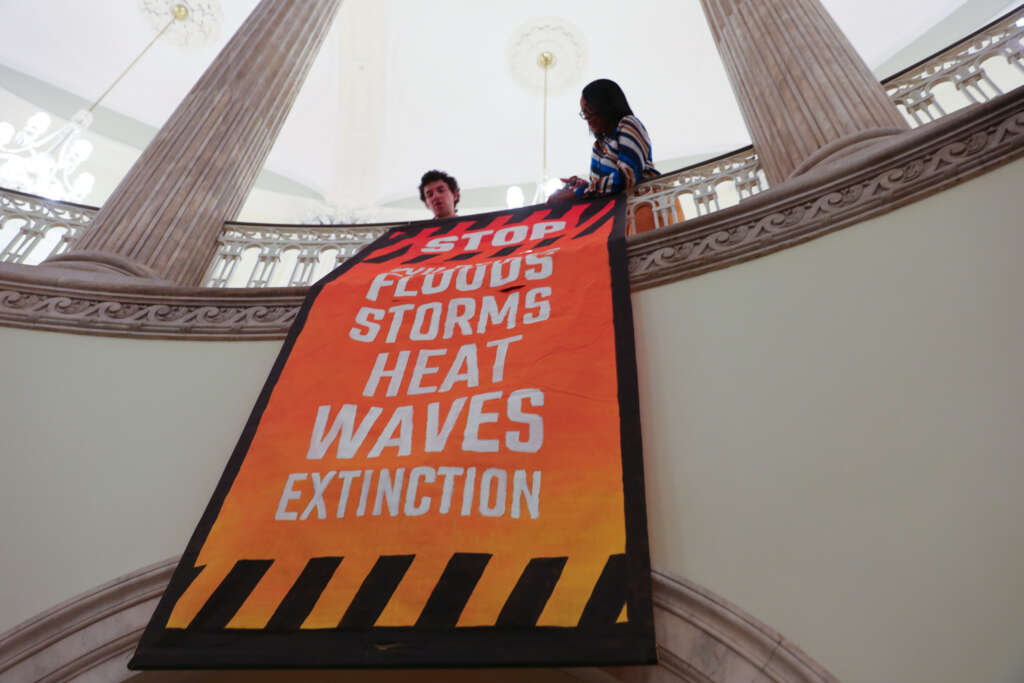

If this summer has shown New Yorkers anything, it’s that the ramifications of climate change aren’t knocking on our door anymore; they’re bursting through it. They’re bursting through the seams of aging stormwater drains and subway stations on a rainy day. They’re evaporating off of sizzling pavements during one of our many record-breaking heat waves. There’s no denying that the impacts of climate change are already here.
A recently released U.N. report, “Limiting Overshoot,” makes it clear this is only a preview of what’s coming. Scientists now set a best-case scenario of a 1.8 degree Celsius peak, which is already past the 1.5 degree Celsius goal agreed to in the Paris Agreement—already a catastrophic loss for our planet. Every fraction of a degree beyond that sets off a cascade of worsening climate events. We’re talking about the loss of entire ecosystems, water, food, and power supply interruptions, mass climate migrations, and an overall disruption of life as we know it.
Nothing can make this an easier pill to swallow. But the shift from accepting these scenarios to acting on them is exactly what will protect our world, and our city, from the worst of what’s coming. That shift could be the difference between a family staying in their home instead of watching it wash away in a flood. It’s the difference between a life saved or another New Yorker who dies needlessly from extreme heat.
As a city, we shouldn’t accept that some of us will drown in flooded basement apartments or that 500 of us will die of heat-related illness each year as par for the course. If we don’t take serious and aggressive climate action now, these heartbreaking trends will only deepen.
The U.N. report lays out the climate interventions still available to us. Here in New York City, that means passing and implementing serious climate legislation that lowers our emissions, cuts our reliance on fossil fuel, and improves public health for everyone who lives here.
It means passing bills like Intro 359, to expand our renewable energy infrastructure by requiring the city to install at least 400 megawatts of energy storage capacity on city-owned lots by 2035. It also means holding corporations and governments accountable to cut down on emissions, reduce packaging waste through banning our city from procuring single-use plastics, and accelerate a transition towards renewable energy as swiftly and thoroughly as possible.
For years, climate intervention in the mainstream has amounted to placing too heavy an importance on small individual actions that don’t match the scale of the problem. These actions are a vital part of the solution, but our collective action must go beyond the reduce, reuse, recycle mantras and reckon with the larger powers and systems most to blame. Together, we can hold corporations and the government accountable to change course. Climate Week is a moment to remind ourselves of our ability to take concerted action.
This isn’t to say that New York City hasn’t taken major steps towards securing our climate resiliency. When we passed legislation like Local Law 154 to phase out fossil fuels in new construction, Universal Residential Composting and the Public Solar Bill, we led the way as a city that’s committed to high-impact, environmental action.
What we need now is connected, citywide action aimed squarely at our biggest polluters: the corporations that have enriched themselves by sacrificing our communities’ futures.
The window of opportunity to prevent the worst of the climate catastrophes predicted is within our grasp. The way through is still available to us, but only if we commit as a city to comprehensive action on our climate goals.
Sandy Nurse and Harvey Epstein are members of the NYC Council, representing Brooklyn’s District 37 and Manhattan District 2, respectively.