


Share This Article
Tenants at five apartment complexes in Harlem and on Roosevelt Island say the switch to submetering has led to sky-high electricity bills, despite their efforts to conserve. “We don’t even use the microwave,” said Corazon Grajales, who said her monthly bill remains close to $400. “It barely makes any difference.”
Every night before she goes to bed, Corazon Grajales walks around her East Harlem apartment unplugging anything she thinks might be using electricity. Appliances come out of the wall. So does her internet router. She has stopped using her air conditioner, too.
Still, she says, she can’t seem to lower her electric bill. After moving into The Crossing apartment complex in February 2025, Grajales’ first bill was $538. Even after changing her habits in an effort to conserve electricity, she says her monthly charges remain close to $400.
“We don’t even use the microwave,” Grajales said. “It barely makes any difference.”
Earlier this year, residents at The Crossing, The Landings, The Heritage, The Miles and The Parker—five apartment complexes owned by L&M Development Partners across Harlem and Roosevelt Island—began receiving electric bills from Metergy Solutions, a submetering company. Previously, electricity had been included in tenants’ rent, a common arrangement in older buildings that were not designed to measure each apartment’s electricity consumption individually.
When electricity is included in rent, the building owner is responsible for the utility bill, making electricity an operating expense that can rise or fall depending on residents’ consumption and energy prices. To avoid this, building owners can contract with companies like Metergy Solutions to retrofit their buildings with submeters.
Submeters measure the electricity consumed by individual apartments, allowing residents to be billed directly for their usage. Tenants then become responsible for the energy their units consume, as they are in most modern apartment buildings.
By charging for precisely what they use, submetering is meant to encourage tenants to conserve energy. Put simply, if tenants are responsible for their own electricity costs, they have a financial incentive to use less.
But as the tenants at these L&M properties learned, simply retrofitting older buildings with submeters does not necessarily give renters the ability to meaningfully reduce their bills. Some say they are using far more for electricity than they did in previous apartments, and are struggling to understand what’s driving the higher costs.
The tenants say the answer lies in the condition of the buildings themselves. Older buildings can be poorly insulated and equipped with aging, energy-intensive heating and cooling systems, leaving residents with limited control over how much energy their apartments consume. When those buildings are submetered, tenants can end up bearing those inefficiency costs directly.
Before moving to The Crossing, an apartment complex on First Avenue and East 102nd Street, Grajales lived with her four children in a similarly sized apartment on Staten Island. She says her monthly electric bills there were a fraction of what she pays now, despite her efforts to conserve electricity in her new apartment.
She also claims her bills are high even when she’s not home. Last summer, Grajales said, she went on vacation for about three weeks. Despite the apartment being empty, she said the cost was nearly the same as usual.
“My bill was close to $400, and I’m like, ‘This is impossible,'” Grajales said. “I was away. I went out of state.”
Across the five properties owned by L&M Development Partners that switched to submetered billing last year, Grajales’ case is far from unique. The problem is particularly stark at The Landings, the largest of the developments, with 1,003 units. According to NYC’s Accelerator Building Energy Performance Map, the complex has an Energy Star score—a national metric rating a building’s energy efficiency—of just 16 out of 100.
Zach Ephron, a tenant at The Landings, said the tenants association there has collected hundreds of Metergy bills from residents since the complex switched to submetered billing in January, giving organizers a broad picture of just how high the charges can climb.
“The average electric bill for a three-bedroom was between $700 and $750,” Ephron said. “A few were well over $1,000 per month.”
For some residents, the size of the bills was not the only surprise. Tenants say poor communication about the transition to submetering has left them uncertain about when billing began, how much they owe and, in some cases, whether they were responsible for paying for electricity at all.
“I was confused, because when I moved in, they told me that electricity was included in the rent,” said Charles Ouedraogo, who has been a resident at The Landings on Roosevelt Island since 2024.
Ouedraogo is one of many L&M tenants who claims he was unaware of the shift to submetered billing until he started coming home to notices on his front door telling him he had an outstanding balance of $1,389, and threatening to turn off his power if he didn’t pay.
“They don’t mail us the bills, they email us, but a lot of people haven’t gotten emails or it’s gone to an old email, because management gave Metergy an old email address,” says Ephron. “Some people’s children have gotten Metergy bills because management gave them the wrong email.”
Another point of frustration for tenants is the complex’s electric baseboard heaters. While the cost of running the heaters themselves is covered by the building owner, residents say the devices—which pre-date current ownership—are poorly installed and allow significant amounts of airflow into the apartments, driving up their heating and cooling costs.
In the winter, the heaters do not adequately warm their homes, tenants say, forcing them to rely on space heaters or even their ovens to stay warm—further escalating their already-high electric bills. Many residents also distrust the accuracy of their meters, including whether they properly track the electricity consumed by the baseboard heaters, a cost that gets deducted from their utility bills each month.
Metergy scheduled an informational session on July 30 in the lobby of 546 Main St. on Roosevelt Island—one of several towers that make up The Landings—to address residents’ questions.
Many came looking for an explanation for their unexpectedly high bills. Others wanted to understand why they were receiving bills in the first place. But when far more people arrived than Metergy had anticipated, the company abruptly canceled the meeting, which was never rescheduled.
Meanwhile, tenants told City Limits they’ve continued to receive daily phone calls and shut-off notices on their front doors from Metergy, warning that unpaid balances could be reported to credit agencies or result in their power being turned off.
They say getting answers about the charges has proven difficult. Residents who contact Metergy with questions about their bills say they are often directed to property management, while those who raise the same questions with management say they are sent back to Metergy—leaving them caught between the two companies while bills continue to pile up.
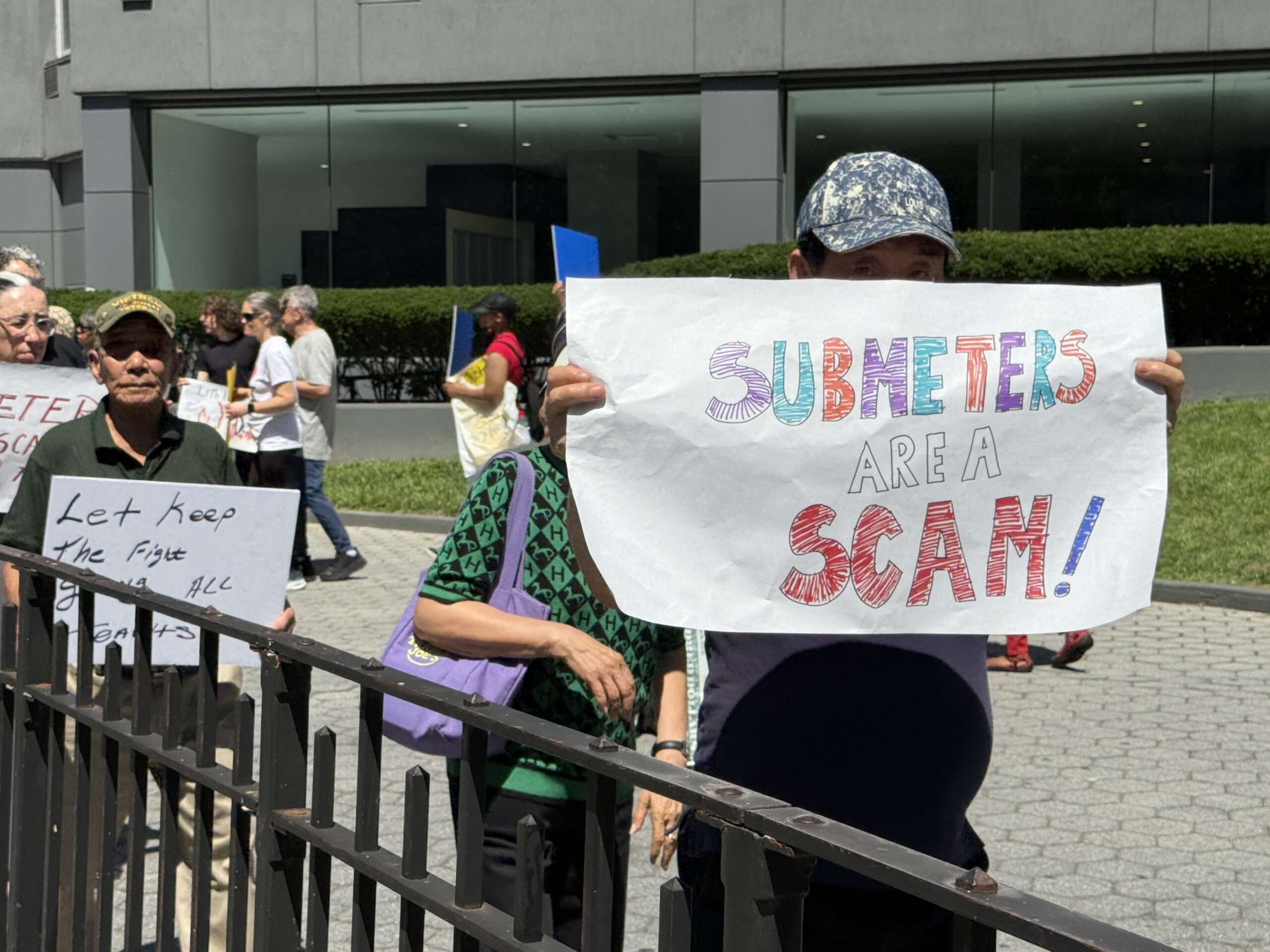
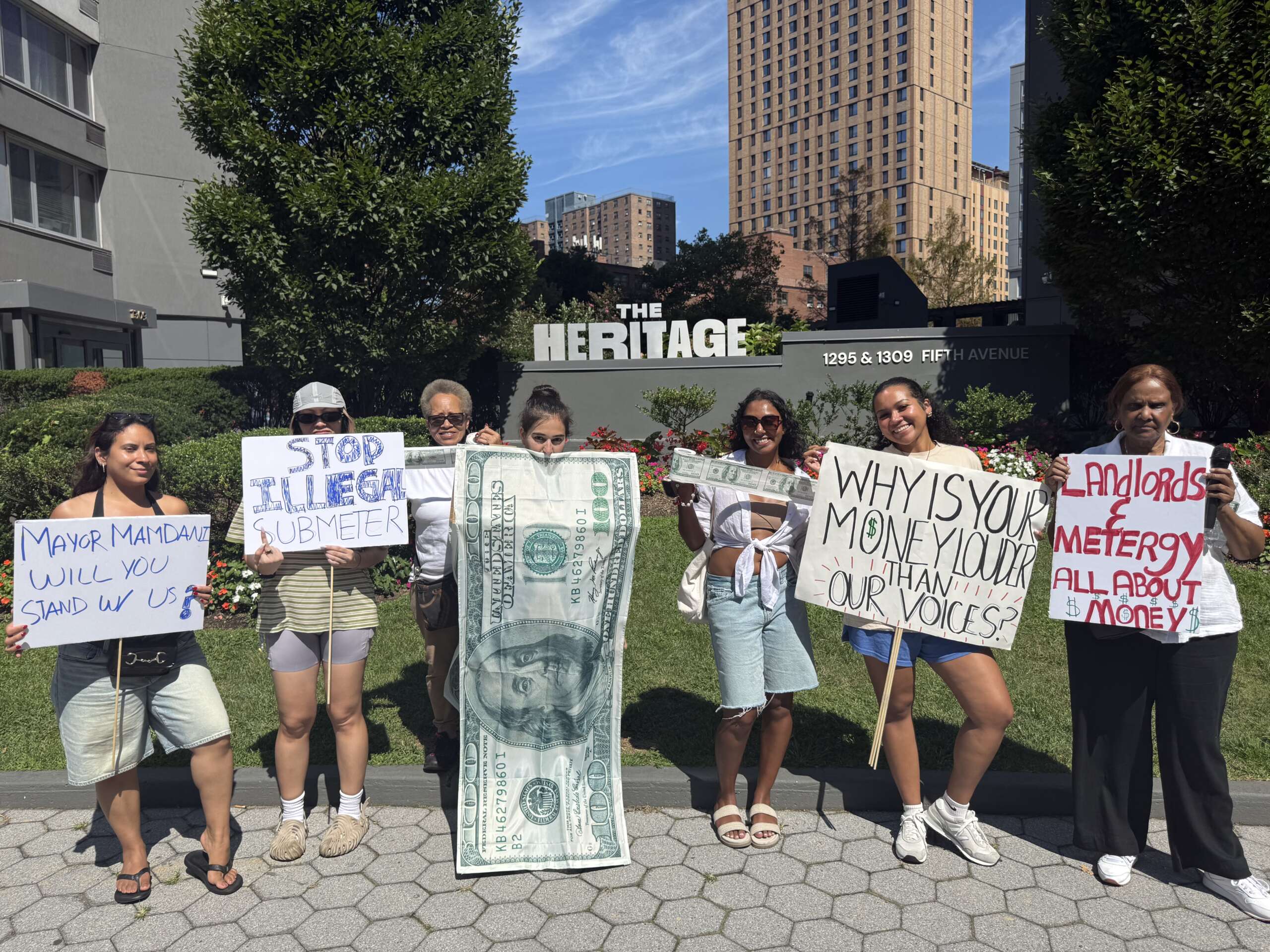
Feeling they had run out of options, residents from the submetered apartment complexes began to mobilize. On Aug. 15, demonstrators rallied outside The Heritage, an apartment complex also owned by L&M on Fifth Avenue and East 110th Street, holding signs to protest their high electric bills, Metergy’s aggressive collection tactics, and what they describe as a lack of transparency and responsiveness by both companies.
Steering her walker along the picket line with one hand and holding a protest sign with the other, 81-year-old Claire Underwood—a resident at The Heritage in East Harlem since 1980—says the physical disrepair of her unit makes it difficult to limit how much energy her apartment consumes.
“We have drafts. The air comes through the electricity sockets. It’s horrible,” she said. “My bill was over $700 last month.”
Before a residential building can be converted to submetered electricity, its owner must receive approval from the New York State Public Service Commission (PSC). In this case, the PSC required L&M to make energy-efficiency improvements to the buildings before it would approve the company’s submetering plans.
But tenants at The Landings say those improvements at their complex were merely cosmetic and did little to address the underlying problems driving up their utility bills. Apartments remain drafty and difficult to keep warm in the winter or cool in the summer, they say.
“They just glued six inches of styrofoam to the outside of the building,” Ephron said.
C+C Management, L&M’s property management arm, disputed tenants’ characterization of the work. A spokesperson said submetering is one component of a $50 million capital improvement plan underway at the buildings since 2019, alongside façade overhauls, window replacements and upgrades to building systems.
“Our goal is to make these communities affordable, energy-efficient, and resilient,” the spokesperson said.
The PSC approved L&M’s submetering petitions in April of 2025. Tenants appealed those approvals in court the following month, arguing that the PSC failed to adequately assess the financial impact on tenants, verify that required tenant protections were in place or account for building conditions that could drive up residents’ costs.
But the Commission ultimately ruled against the tenants, citing its longstanding policy of encouraging submetering as a way to conserve energy and more fairly allocate electricity costs. With submetering, the commission wrote, “residents of each unit will bear the true cost of their usage,” so those who consume less electricity aren’t subsidizing those who consume more.
The PSC did not respond to City Limits’ questions before publication.
Bill Salo, a resident at The Heritage and an attorney representing tenants at the submetered complexes, said he plans to appeal the latest decision.
“Landlords push for submetering for one primary reason: to increase profits by shifting energy costs directly onto tenants,” Salo said. “In every other case over the last 25 years, the PSC set rate caps and required landlords to back out electricity costs from the rent. Here, they rubber-stamped an exception that leaves lower-income tenants unprotected.”
C+C also disputed the characterization that residents have been left without support, saying tenants have received rent reductions as they take on responsibility for their electricity bills and that management is available to assist those struggling with their payments, including by helping them enroll in deferred payment plans.
But for Grajales, the dispute has turned even routine parts of family life into a source of anxiety.
“I’m getting worried because my kids are back in school, and the school gives them devices that they have to bring in charged,” Grajales said. “They need them for homework, and I know that’s going to mean a little spike in my energy bill. Why should I have to worry about that? We shouldn’t have to live like this.”
To reach the editor, contact [email protected]
Want to republish this story? Find City Limits’ reprint policy here.