


Share This Article
The city’s latest housing vs. parking battle is playing out at an East Village Mitchell-Lama co-op, where the board is considering the sale to raise money for their 60-year-old buildings. Supporters say it could be a sign of things to come for affordable housing that needs preservation funds.
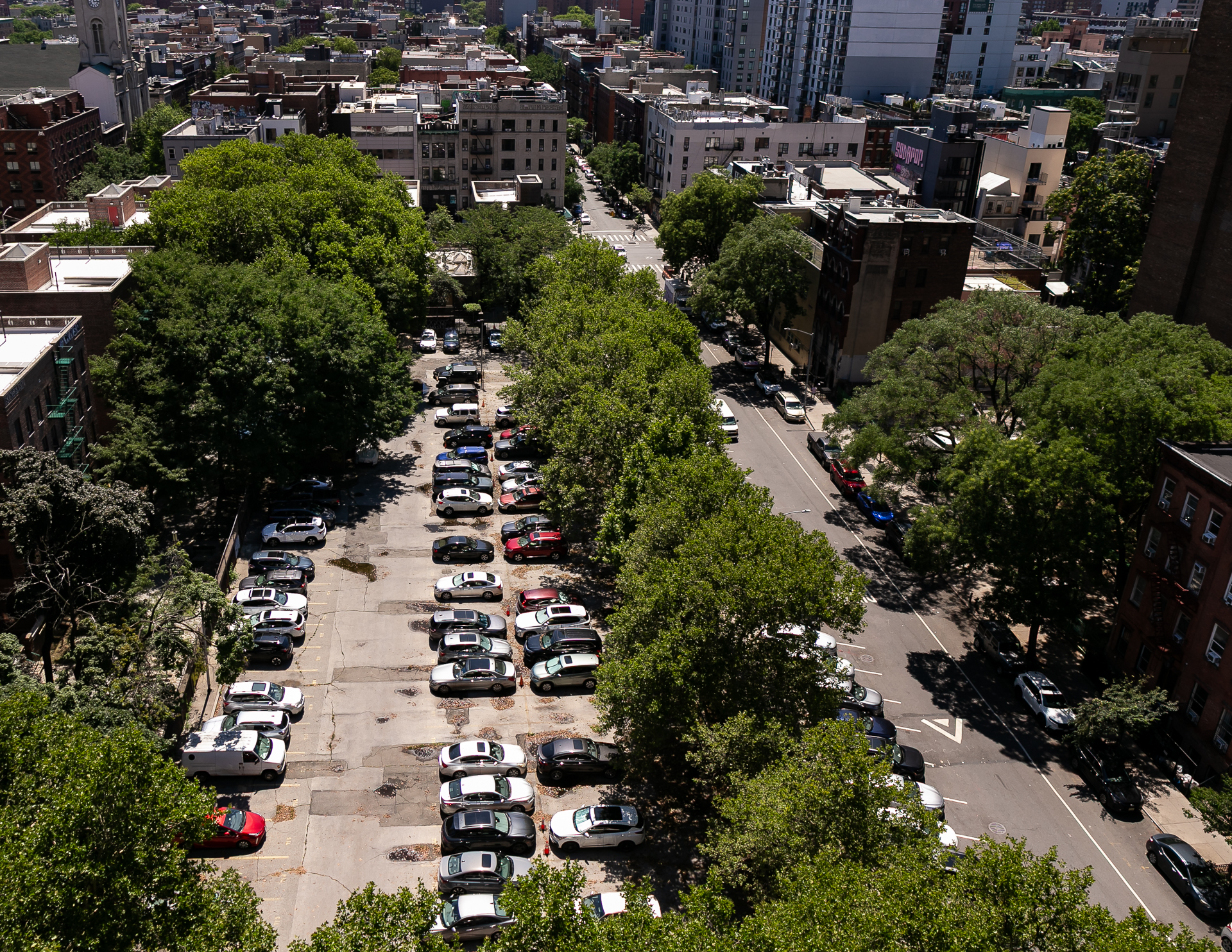
If you were born the year the Village View apartments were built, you’re eligible for social security.
Buildings, like people, require extra care as they age. With financial pressures mounting, the East Village Mitchell-Lama is considering a bold step: selling one of their parking lots to build new housing, generating money for their buildings in the process.
The resident board of Village View, a 62-year-old, 1,200 unit Mitchell-Lama cooperative just South of Tompkins Square Park, says it’s a creative solution that will ensure their apartments can remain affordable, and a model for other affordable housing preservation projects across the city.
But even as the city’s housing agency and local elected officials express support for the idea, some residents—also called shareholders—say they have been cut out of the decision-making process. They criticized the board’s resident engagement and bemoaned the loss of parking spots.
“We feel betrayed, we feel condescended to, and it’s not being done in a democratic way,” said shareholder Stephen L. D’Andrilli.
While the city’s Department of Housing Preservation and Development (HPD) has oversight over the Village View, its board is independent and elected by shareholders, and appears to be advancing the plan despite some vocal opposition. Leadership says they have few alternatives to keep up with rising costs and avoid rate hikes for residents.
“This decision was not made lightly or flippantly,” said board President Christine Hadlow in an email to City Limits. “We pursued this endeavor because of limited revenue-generating options and desperate financial necessity.”
The proposal touches on some housing policy lightning rods: community engagement, parking, and affordability.

Paying now vs. later
The trouble started during the pandemic, said Hadlow.
Maintenance fee collections slowed, utility costs went up, and insurance rates exploded. Village View’s board found itself in a hole.
Residents of the co-op pay monthly maintenance fees, which are kept affordable through subsidies and tax abatements. In response to rising costs, the board forced unpopular maintenance rate hikes of 7 percent a year from 2022 to 2024.
“All this did was provide a Band-Aid solution; we continued to run in the red each month and never had the opportunity to catch our breath,” said Hadlow.
In 2024, the board was forced to revise fees to keep pace with costs, asking HPD for a 15 percent increase in year one, followed by 12 percent and 10 percent hikes.
Across the city, many Mitchell-Lama co-ops faced similar challenges, forgoing unpopular maintenance hikes and deferring maintenance, leading to long term repair needs going unmet.
While it’s become harder to do in recent years, some developments even voted to become private owners of their condos—giving up their affordability protections, but also giving them a chance to sell the units at market-rate—by leaving the Mitchell-Lama program altogether.
“You either have the option to raise maintenance or you have the option to go private,” said Jodi Stein, a land use partner at Sheppard, a law firm hired by the board.
But some Village View residents disputed whether the alarm over future financing was warranted.
Robert LaValva, a former board member and urban planner, said that the board’s lack of transparency about the proposal and the financial state of the development has eroded trust with residents.
“[The board is] taking it upon themselves to decide we were in a crisis without giving us any evidence that we’re in a crisis,” said LaValva.
Even after six years of rate hikes, board members said that in order to avoid even more increases, the board needed to get creative.
“They’re looking for a way to a path forward that keeps their building in the program, but also enables them to have real longevity here, to actually have their residents live comfortably,” said Stein.
Parking vs. housing
The Village View campus, stretching from 2nd to 6th streets between Avenue A and 1st Avenue, is a quiet patch of the otherwise-chaotic East Village, with towers shaped like lightning bolts poking above a generous canopy of linden and elm trees.
Seven brick buildings, home to over 1,200 co-op units, hover above seven surface parking lots.
In 2024, the board commissioned Sheppard to study a sale of parking lot seven on 2nd Avenue, home to 110 of the campus’ 340 parking spots.
“A potential sale of the property could bring in very significant, and much needed, revenue that would stabilize Village View’s finances for years to come and spare shareholders from large, double-digit maintenance increases in the future,” said Hadlow via email.
Sheppard said a sale could generate $30 million for Village View. The board has a fiduciary duty to manage the buildings and HPD, which oversees part of the program, is obligated to make sure their books are balanced. Even with a potential sale looming, HPD approved a maintenance increase of 29 percent over the next three years.
Raising maintenance fees creates awkward political dynamics for Mayor Mamdani and HPD, who are searching for ways to address the rising cost of insurance for residential buildings while also calling for a rent freeze on the city’s rent-stabilized units.
Some residents feel the proposal came out of nowhere, without giving shareholders a chance to make their voices heard.
“It’s hard to assess because [the board members] are so secretive,” said Pat Russell, who has lived at Village View for eight years. They seem “scared of the shareholders,” she added. “We slow them down.”
One resident, Sebastian Kot, says that he gathered over 400 signatures on a petition demanding more transparency about the proposal. He said that this year’s open board meetings limited the time and number of questions residents could ask.
“You’re supposed to have open board meetings with open voting going on in front of our eyes, so we can understand the process of who’s thinking what, who’s getting overridden. What great ideas are getting shuffled under the carpet that we don’t even know about?” asked Russell.
Some residents also want to keep their parking, a valuable amenity in a neighborhood where garages charge over $500 a month and many older residents rely on cars to get around.
Dedicated parking is a precious commodity in New York City—eliminating street parking has fed countless neighborhood fights over new housing, bike and bus lanes, CitiBike docks, and curbside trash bins.
“It’s 1,236 apartments. 900 of those people are interested in parking, whether they have a spot or whether they’re on the waiting list for a spot. That’s a significant percentage of the population, and yet the board is treating this as if it’s no small matter to get rid of the biggest parking lot,” said LaValva.
Starting with the City of Yes rezoning in 2024, which reduced mandated parking in new developments citywide, parking has taken a backseat to new housing supply in the mayor’s housing plan (Mamdani called for eliminating all parking mandates in his campaign platform).
Even some residents who say they might be open to the development plan have been turned off by the process.
“I don’t believe we should be fighting for parking when there’s so much homelessness,” said Russell, who owns a car but said she might support affordable housing if she knew more details about the plan. “I don’t have enough information to say I support it, and I haven’t signed the petition against it, because I don’t know. I wish I did.”
Board members disputed claims that they were withholding information, saying that they distributed financials to shareholders and held open meetings in accordance with program rules. At recent meetings, residents were limited to one question each for the sake of time, according to the board.
“The backlash for any big change is inevitable, you cannot make everyone happy all the time. But we have a fiduciary duty as a board to look at what measure would serve the greater good of our entire community,” said Hadlow via email.
Hadlow also said the board would take steps to preserve as much parking as possible in the plan, including possibly asking the developer to build parking on site that would be accessible to Village View residents.
Yet mistrust runs deep. A state comptroller audit of 15 Mitchell-Lamas last year found significant management issues that caused delayed repairs, and several instances of management misspending funds which city and state agencies failed to catch (Village View was not among the developments audited).
With five of the development’s 15 board members up for re-election this fall, Kot’s petitioners say they are circulating another petition to hold special elections for the other board members, which could upset the balance of power.
“They don’t trust us,” said LaValva. “And we don’t trust them.”
Kot and his petitioners say that the decision to sell a major asset should be subject to a shareholder vote.
But so far, the board and HPD have maintained that the board has the power to sell the land without a vote. HPD and other local electeds support the idea, especially if it means space to build more housing.
City Council District 2 in Manhattan built just 497 units of affordable housing from 2014-2025, ranking 37th out of 51 Council districts.
“I think it’s a smart conversation for the board to be having,” said local Councilmember Harvey Epstein.
“There’s a lot of parking in Village View. The management feels they can continue to make parking available but provide this land for critical housing in a neighborhood that really needs it,” added State Sen. Brian Kavanagh, who represents the development in Albany.
Selling significant assets can feel painful, but is one of few levers to generate significant revenue for aging projects like Village View. NYCHA, the city’s public housing agency, has quietly tested infill projects, like when it sold a plot of land to fund repairs at the Manhattanville Houses in Harlem.
“It is a creative solution, and it is a way to provide more housing in the city, when you have a 1.4 vacancy rate,” said Eva Schneider, a land use lawyer with Sheppard.
Preservation dollars vs. new affordable housing
The proposal begs another question: what would actually get built on lot seven?
Any deal to bring affordable housing to the site introduces an uncomfortable tradeoff: every new affordable unit likely means less money for preserving Village View. Mandating a developer build more parking than zoning requires could also increase costs and lower the sales price.
Under one possible development scenario, Sheppard said, a developer could build an as-of-right building using the state’s 485x tax subsidy, commanding $30 million for the land and making about a quarter of the units affordable.
The plot, in the heart of the East Village, just blocks from the 2nd Avenue F train station, is a desirable place to build (and live). But a larger project that increases density on the site might be subject to City Council review, and incite calls to include more affordable housing.
While there is currently no land use change proposed for the lot, Epstein told City Limits that affordable housing would be his priority in any new development.
But each new affordable unit mandated would decrease the land’s sale price, cutting into the money generated for Village View.
“The tension is between maximizing money for the Mitchell-Lama versus maximizing affordable housing opportunities [at the site],” said Epstein.
Greater affordability might also require additional subsidy from the city’s housing agency, HPD—money that wouldn’t go to other affordable housing projects. The city and state have poured millions of dollars into Mitchell-Lama’s coffers over the years, either through direct subsidies or foregone tax revenue, like when they cut their taxes in half last year.
“There’s a lot we do to support the Mitchell-Lamas, and we’ll continue to do that. We’re not saying, just go figure it out for yourself. The boards have a right and a responsibility to do what makes sense for their neighbors, and making the finances work,” said Kavanagh.
The Mitchell-Lama condos have stayed affordable for over 60 years, and officials and residents believe the program can, and should, adapt. Consensus on how to adapt is another story.
“Mitchell-Lama could be a prototype for the nation,” said Russell. “We could have social housing to challenge the social housing in Europe… but the greed aspect here has gotten in and caused rot.”
She hopes Village View’s shareholders can take a long-term view: avoid privatization, keep things affordable, and make decisions more inclusively.
“[Some residents] want not only low rent and affordable housing, they also want to build fortunes,” she said. “They don’t get that the benefit they get from this social housing is in the living in it, it’s not in the payout later.”
To reach the reporter behind this story, contact [email protected]. To reach the editor, contact [email protected]
Want to republish this story? Find City Limits’ reprint policy here.
7 Comments
PS
Just because a few people are whining about parking, does not make this “controversial”. Really shameful how egoistic NIMBY considerations trump what is quite obviously a sensible thing to do: Build housing and discourage car ownership by making parking more of a headache. If people living there do not like it, they can move out. If they can afford a car, they can probably afford to live somewhere else as well as a private garage, perhaps. Plus, we live in 2026, not the 70’s. Cars destroy cities and make life awful for everyone. But this is not a consideration of entitled car owners, of course.
Guest
I agree. I bet most residents get by just fine without a car.
pj
this sale will not turn into “affordable housing”, everyone selling this notion is participating in a lie. it will be yet another ugly “luxury” building with 3-4 “affordable units” at 140% of the median income, which translates into $3500 studio apartments, so that people who work in finance can continue to ruin the neighborhood. Ludicrous that anyone believes this nonsense. Look up Sheppard Mullin & how much “affordable housing” they deal with, Jodi Stein. herself told the shareholders that they “couldn’t afford her” at the last open meeting this corrupt board held. The development is “in critical debt” to a tune of less than a million dollars, yet they spent over $300,000 on lawyers & lobbyists like Stein? That makes zero financial sense This appears to be nothing more than a grift by a corrupt board & property manager looking to line their own pockets & probably paying off their cronies at HPD & local politicians in order to do so. Epstein & Kavanagh should be ashamed of themselves Google the property manager of Village View & you’ll see how many cases against them for dirty dealings already exist. The state comptroller certainly needs to audit Village View as well & see who among the board & property manager are already engaging in self-dealing at the complex’s expense, even before this proposed sale of a major asset like the parking lot land
pj
this sale will not turn into “affordable housing”, everyone selling this notion is participating in a lie. it will be yet another ugly “luxury” building with 3-4 “affordable units” at 140% of the median income, which translates into $3500 studio apartments, so that people who work in finance can continue to ruin the neighborhood. Ludicrous that anyone believes this nonsense. Look up Sheppard Mullin & how much “affordable housing” they deal with, Jodi Stein. herself told the shareholders that they “couldn’t afford her” at the last open meeting this corrupt board held.
The development is “in critical debt” to a tune of less than a million dollars, yet they spent over $300,000 on lawyers & lobbyists like Stein? That makes zero financial sense This appears to be nothing more than a grift by a corrupt board & property manager looking to line their own pockets & probably paying off their cronies at HPD & local politicians in order to do so. Epstein & Kavanagh should be ashamed of themselves & Stein will get her cut. Google the property manager of Village View & you’ll see how many cases against them for dirty dealings already exist. The state comptroller certainly needs to audit Village View as well & see who among the board & property manager are already engaging in self-dealing at the complex’s expense, even before this proposed sale of a major asset like the parking lot land
pj
why are you deleting comments that disagree with the Board, the politician’s & the real estate developer’s narrative (aka one & the same)? There will be NO “affordable housing” built at this site if HPD allows the sale (but there will be a hefty profit for Sheppard Mullin!). At most, it will be 1/4 of the total apartments built at 140% of the area median income = $3500/ month studio apartments, like at every other “affordable housing” lottery across the currently. You’d think Harvey Epstein would be a little smarter about this real estate developer con after years of watching it play out again & again in the east village while it destroys what make this neighborhood great, but apparently not
Jeanmarie Evelly
Hi there, we didn’t delete any comments on this thread. We review comments before publication so sometimes there’s a lag between when you submit and when it shows up publicly (like over the weekend when our office is closed). Thanks for reading!
Guest
The demand for this location is enormous. They should definitely seek a zoning change to maximize the number of potential units constructed.