


Share This Article
Advocates and progressive state lawmakers continue to call for passage of the New York for All Act, which would prohibiting local law enforcement agencies from carrying out civil immigration enforcement in any way.
Lea la versión en español aquí.
Gov. Kathy Hochul on Thursday announced a handshake deal on New York State’s 2027 budget, which is expected to include policy changes aimed at protecting immigrant communities from the Trump administration’s mass deportation campaign.
Although advocates and progressive state lawmakers are pleased with what’s included, some called for the state to take a harder stance: prohibiting local law enforcement agencies from carrying out civil immigration enforcement in any way.
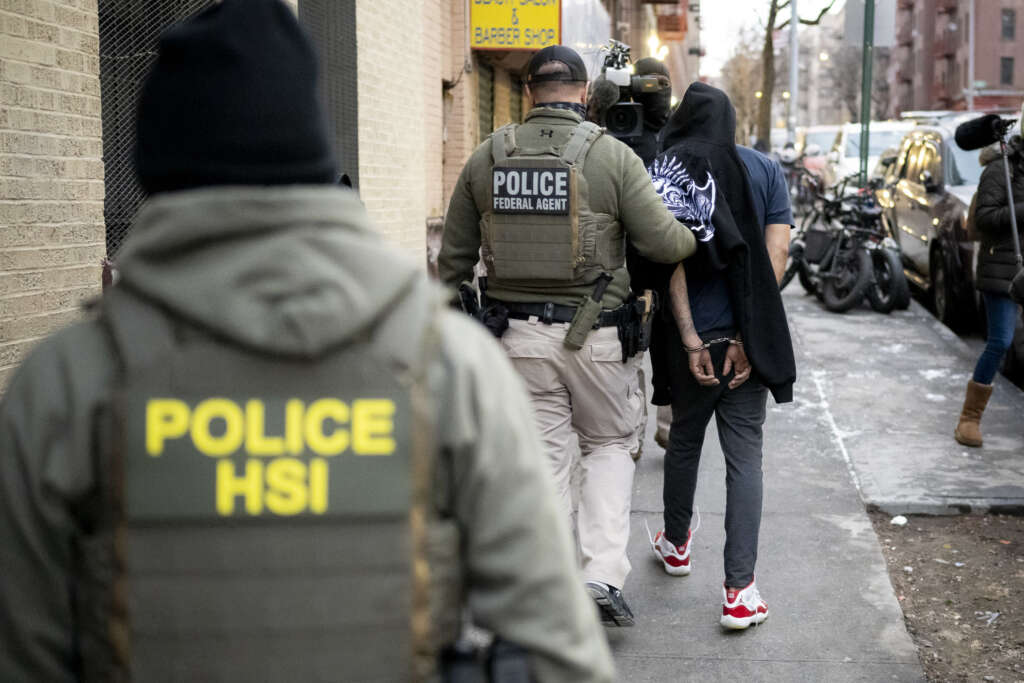
During President Donald Trump’s second term, federal immigration agents have ramped up arrests of immigrants without criminal records and staged mass, visible raids on homes, workplaces, and commercial streets.
The surge in ICE stops and detentions has greatly disrupted life for many immigrant New Yorkers, particularly Latino communities that have been targeted for enforcement.
“People are hiding,” Hochul acknowledged during a press conference Thursday. “These are hard working people that are contributing, adding to our economy.”
The governor’s proposals include eliminating 287(g) agreements, which allow state and local police to work with ICE. These types of partnerships exploded across New York last year, and was, by far, the most widely celebrated point among advocates and state lawmakers.
While New York City and a few other counties have enacted sanctuary policies that restrict local government cooperation with immigration enforcement, most jurisdictions across the state don’t. As of May, local authorities and ICE have signed 14 formal agreements.
“We’ll help you go after the hardened criminals, the violent, the worst of the worst,” Hochul said of the new restrictions. “I’m in the front of that effort. We all are. We have been. This does not restrict our ability to help in criminal situations, and I want people to understand that.”
While Assembly Speaker Carl Heastie said Thursday that there was no final budget agreement yet, sources say that what was announced on immigration is locked down.
“There are some really good ICE accountability measures that we came to agreement on, which I’m very supportive of,” said State Sen. Andrew Gounardes, who represents parts of Brooklyn. “but I’m disappointed that despite the best efforts of the legislature, the Senate and the Assembly, we were not able to break or to ban the worst type of collusion that we see happening with ICE, and that’s with local law enforcement.”
For years, advocates and lawmakers have pushed for the passage of the New York for All Act, which would eliminate collaboration between local police and federal agents carrying out civil immigration enforcement. However, Hochul has never fully endorsed the bill.
While the governor’s proposal addresses formal agreements between ICE and New York authorities, it does not ban other, less official cooperation with federal immigration authorities, like when local police call ICE after a traffic stop.
During Thanksgiving week last year, for example, a Latino Port Chester resident was stopped by local authorities for having tinted windows on his car while driving to church, according to Jennifer Hernandez, director of campaigns at Make the Road, recalled.
“His family was told that he would be released in like three hours,” Hernandez explained. “They went to try to pick him up. The police basically said, ‘Oh no, he’s not ready, come back later.’ And then, because they were sharing locations, his wife noticed that he was being transported to downtown Manhattan. He had been basically transferred. He had been given over to ICE.”
Despite the fact that Port Chester—a village in southeastern Westchester County, on the border of Connecticut—has no current 287(g) agreement with ICE, the Peruvian father was detained and transferred to Louisiana, and ended up self-deporting after falling ill, according to Hernandez.
“One of the biggest gaps in what the governor has presented has been that there’s no tackling of the informal collusion that happens between local police and ICE and immigration enforcement,” Hernandez emphasized.
The Immigrant Defense Project has been tracking collaboration between ICE and local authorities, and there have been dozens of these kinds of cases in the last few months in New York, said Linda Flor Brito, senior manager of policy and organizing.
“It’s extremely devastating and disappointing,” Brito said of elected officials’ failure to include the full scope of the New York for All Act, which “would actually prohibit local law enforcement from colluding with ICE and continuing to funnel people into the deportation machine.”
According to Sen. Gounardes, who sponsored the legislation, the state will require local agencies to phase out their 287(g) agreements upon budget enactment, while new agreements will be prohibited.
This includes ICE Detention Bed Contracts, which allow ICE to rent beds to house immigrant detainees in local jails or prisons (current contracts would be allowed to continue until they expire).
Just days before the measure was announced, Tom Homan, President Donald Trump’s border czar, threatened to “flood” New York with ICE agents if the state limits its cooperation with the agency.
“I don’t take well to threats,” Hochul said when asked about Homan’s comments Thursday. “They’re going to find that out. We’re going to pass what we think is important to protect New Yorkers, and to protect schools from being raided and kids coming outside and finding their parents gone.”
The governor said the budget deal also includes establishing a “state right” to sue federal, state, and local officers for constitutional violations; banning federal, state, and local law enforcement from wearing masks––although there are few details on how it would be implemented––and codifying residents’ right to a free public education regardless of immigration status.
Advocates said this point is “preemptive” in case the federal government moves to repeal that right, and is a direct response to other states that are trying to restrict undocumented children from public schools.
Finally, the budget is expected to prohibit the use of state resources for immigration enforcement and deny ICE permission to enter sensitive locations without a judicial warrant, a change spurred by a message from ICE to its agents earlier this year instructing them to enter homes without a warrant, as well as other practices, such as making arrests in schools or healthcare facilities.
“That’s sort of the standard,” said Hernandez, “that an ICE agent should provide a judicial warrant in order to be able to access any place that’s private.”
To reach the reporter behind this story, contact [email protected]. To reach the editor, contact [email protected]
Want to republish this story? Find City Limits’ reprint policy here.
1 Comment