


Share This Article
On at least four occasions, New York State Sen. Luis Sepúlveda, who also has a private law practice, failed to appear in court for tenants he was defending from eviction. Housing court judges chastised him at least twice, and more than one tenant lost their case as a result.
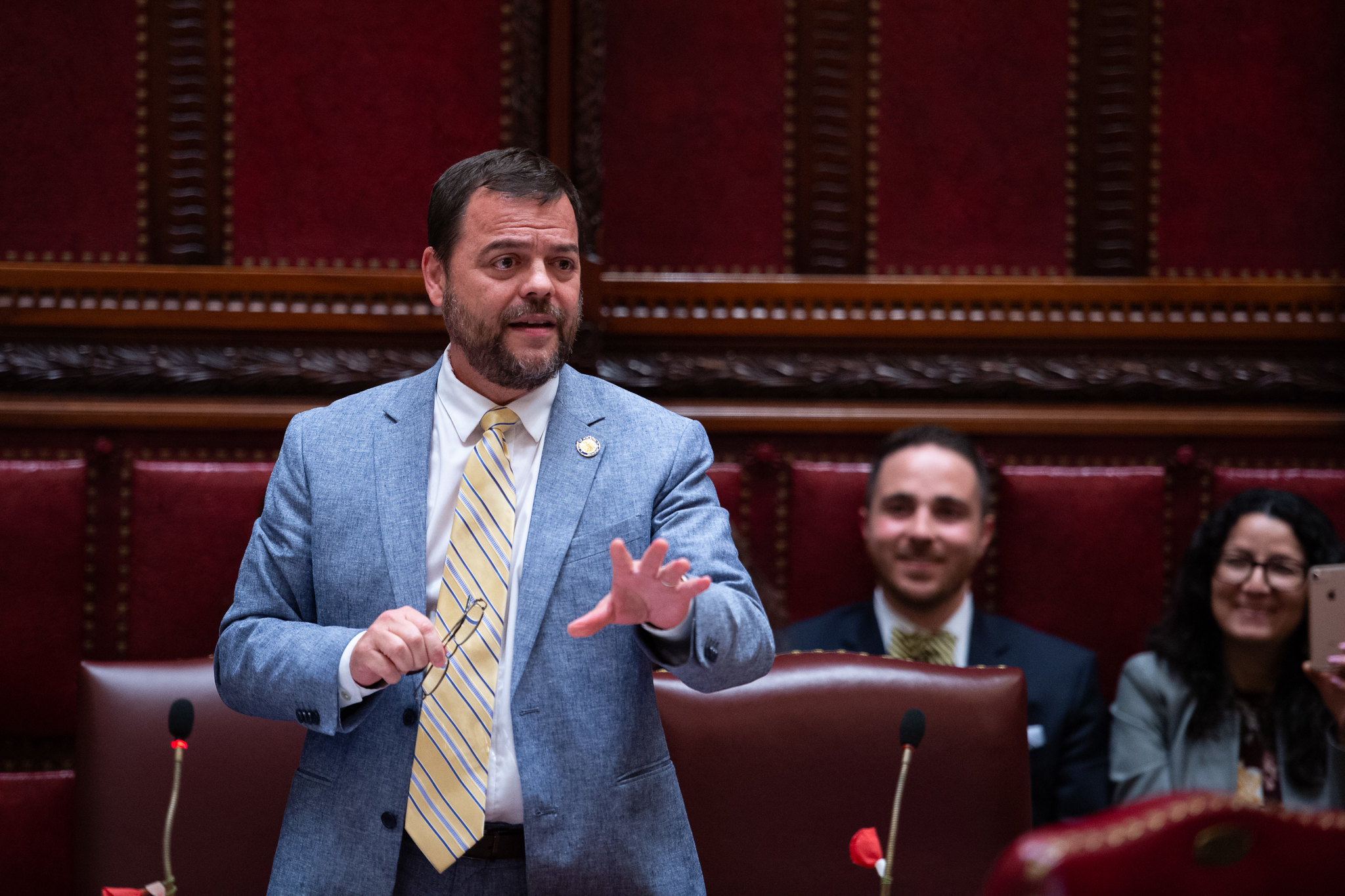
Facing eviction, Stephanie Perez showed up at 9:30 a.m. Monday at housing court on Grand Concourse in the Bronx. Her attorney, New York State Sen. Luis Sepúlveda, did not.
It wasn’t the first time. Sepúlveda, who represents a swath of the Central Bronx in Albany, also has a law practice and takes on a range of clients, including housing cases.
But Sepúlveda had yet to file an answer—the first step in an eviction defense—when he was due in court on Monday morning to represent Perez, whose landlord filed to evict her after she said she began withholding rent in order to force repairs. The lawmaker had already tried to reschedule an earlier hearing in February in the case, records show.
“He’s never physically appeared in court… which is a bit outrageous,” said the landlord’s attorney, William Sheehan, in court Monday.
Bronx housing court Judge Madalina Danescu asked Perez to call Sepúlveda from the stand. When the senator picked up, Perez held her cell phone up to the court’s microphone.
“I’d like to know why you are not here,” the judge said. “It is not appropriate to not appear on multiple occasions.”
Sepúlveda replied that he was “not in New York State right now.”
Despite being retained as Perez’s attorney in early February, Sepúlveda hadn’t answered the landlord attorney’s petition before the appearance, which led to Perez facing an “inquest” Monday—a legal proceeding that only gets scheduled when there is an unresponsive defendant.
The court’s frustration with Sepúlveda was apparent. When the lawmaker said he was having trouble hearing the judge through his client’s speakerphone, Danescu snapped: “Perhaps if you were here you could hear me.”
In a phone interview, Sepúlveda suggested that there was confusion in Monday’s proceedings because of two different cases concerning Perez, though he could not discuss the details, citing attorney-client privilege.
“You’ve got to look at different strategies and on paper you can’t tell,” said the lawmaker, who was first elected to his State Senate seat in 2018. “I’ve been a practicing attorney for 35 years, and never once has a complaint been filed against me by a client.”
But a City Limits review of Sepúlveda’s court cases found at least four instances, including Perez’s case, in which he failed to appear in housing court. His absences rankled judges, frustrated opposing counsel, and sometimes cost his clients—both residential and commercial tenants.
In March, Sepúlveda, who also chairs the Senate’s Judiciary Committee, was the target of a strongly-worded decision from Hon. Jason Vendzules, who criticised the lawmaker when he failed to show up to defend a tenant struggling with cancer in another residential eviction case.
Attorneys can ask the court to move court dates they cannot make. Sepúlveda has done so before, especially during the State Legislature’s busy spring sessions from January to June.
In the past, Sepúlveda has submitted affirmations of unavailability that delayed cases, citing his legislative responsibilities. But he didn’t always send them in time, and has missed appearances with no evident conflict with the state’s legislative calendar and no letter excusing himself.
In the case with Judge Vendzules, Sepúlveda wrote to the court in February saying that he could not appear on Feb. 23 due to his obligations in Albany.
But it appears that he forgot to follow up. He failed to inform the court he also could not attend a subsequent appearance on March 13, which he missed, despite the judge already rescheduling the appearance once. The legislature was not in session that day.
“The Court chose that date after accessing the legislature’s calendar to make sure that it was not in session that day. The court placed the appearance on its calendar (triggering an ecourts notification) and sent postcards to the parties informing them of the adjournment,” Vendzules wrote in his decision.
“Counsel apparently did not check with the clerk after the February court appearance to see if his adjournment request was granted and claims not to have received the postcard sent. These circumstances do not provide a reasonable excuse for the default,” the judge added.
In that case, Vedzules refused to reverse the default judgement—an automatic decision when the respondent doesn’t show—that permitted the landlord to continue eviction proceedings, a decision that frustrated the senator.
“His frustration was that he was representing a client who’s unfortunately suffering from cancer,” said Mike Nieves, a spokesperson for the senator’s re-election campaign.

Legal experts told City Limits that Vendzules was well within the law to reject Sepúlveda’s attempts to resuscitate the case after his no-show.
“Clearly it’s preferable that he calls the court ahead of time, but sometimes his travels and his schedule doesn’t allow for him to do so,” said Nieves.
Shortly after that decision criticizing Sepúlveda, Vendzules abruptly quit, the news site Hell Gate reported. He was reportedly back on the bench this week, according to multiple sources.
Sepúlveda was appointed chair of the Senate Judiciary Committee in January of this year by Senate Majority Leader Andrea Stewart-Cousins. In a press release he issued after his appointment, the senator said he wanted to use the role to prioritize “efficiency in judicial processes.”
The committee has significant oversight over the state’s court system, including judicial appointments, as well as review of all legislation relating to state and local courts.
Good government groups subsequently questioned how Sepúlveda could practice in front of the same judges whose appointment he may influence. Though the senator doesn’t have direct control over housing court appointments in New York City, sources suggested that his powerful position might give him more leeway than the average tenant defense lawyer.
His campaign spokesman disputed this. “When he walks into a courtroom he acts as an attorney, he doesn’t act as the senator from the Bronx,” said Nieves.
Not showing up in housing court significantly disadvantages a tenant, according to attorneys who spoke with City Limits. Most tenants don’t have representation even when they do show up—despite New York City’s efforts to give every low-income tenant facing eviction a lawyer.
It’s a treacherous road back from a default judgement. In order to save a tenant from eviction, attorneys need to show a good excuse for the default and prove that their case has merit—then actually argue and win it.
Two housing attorneys—granted anonymity to speak candidly about the powerful senator—said that if they failed to show as frequently as Sepúlveda, they’d expect to be fired or disciplined.
Failure to appear also wastes the already-overloaded court’s time, according to people familiar with how the court system works.
Sepúlveda doesn’t take on many eviction defense cases—about nine in the past four years—but in the past two years, he failed to show up four times in his five most recent cases.
That includes last year, when Sepúlveda failed to appear for a July hearing to defend the Bronx Optical Center from a commercial eviction. In court papers, he blamed the absence on his assistant putting the wrong date on the calendar.
The judge gave him another chance to appear on Aug. 18. Shortly thereafter, Judge Andrea Krugman denied his motion, ruling in favor of the landlord and writing that the “respondent is denied as respondent failed to appear.”
And in early 2024, Sepúlveda failed to appear for an inquest in Manhattan housing court, resulting in a default judgement against a rent stabilized tenant.
His communications team did not immediately respond to detailed questions about missing appearances in prior court cases and how he is balancing his law practice with his legislative obligations.
On Monday, Perez wasn’t expecting Sepúlveda to show up, but it’s a good thing she went herself.
After Judge Dansecu scolded Sepúlveda, she gave him an hour to show up before recalling the case. Instead, Sepúlveda says he had someone appear on his behalf Monday afternoon.
That was Vicky Capone, a per-diem lawyer who said she usually represents landlords, who told City Limits she got a call from a colleague asking her for a favor. After lunch, she was arguing Perez’s case before the judge.
Capone met Perez just minutes before the appearance and read the case documents on her phone.
Perez had been withholding rent from her landlord since March 2024 because of outstanding rodent and mold issues in her rent-stabilized apartment, she said. Withholding rent because of serious repair issues is legal in New York, and Perez also filed two lawsuits to compel her landlord to make the fixes.
“I never had any issues with my tenancy until I started asking for repairs,” said Perez.
The landlord’s attorney, unwilling to settle and perhaps sensing his leverage, got the case sent to trial in May.
“The attorney of record actually has to appear and represent his client,” warned Danescu.
To reach the reporter behind this story, contact [email protected]. To reach the editor, contact [email protected]
Want to republish this story? Find City Limits’ reprint policy here.