


Share This Article
“For many Latino voters, especially first-generation immigrants and older voters, Spanish is still the language they use most comfortably when discussing important issues,” said Eddie Cuesta, executive director at the civic organization Dominicanos USA. “When a campaign communicates only in English, it can create a real information gap.”
This story was produced in collaboration with Factchequeado.
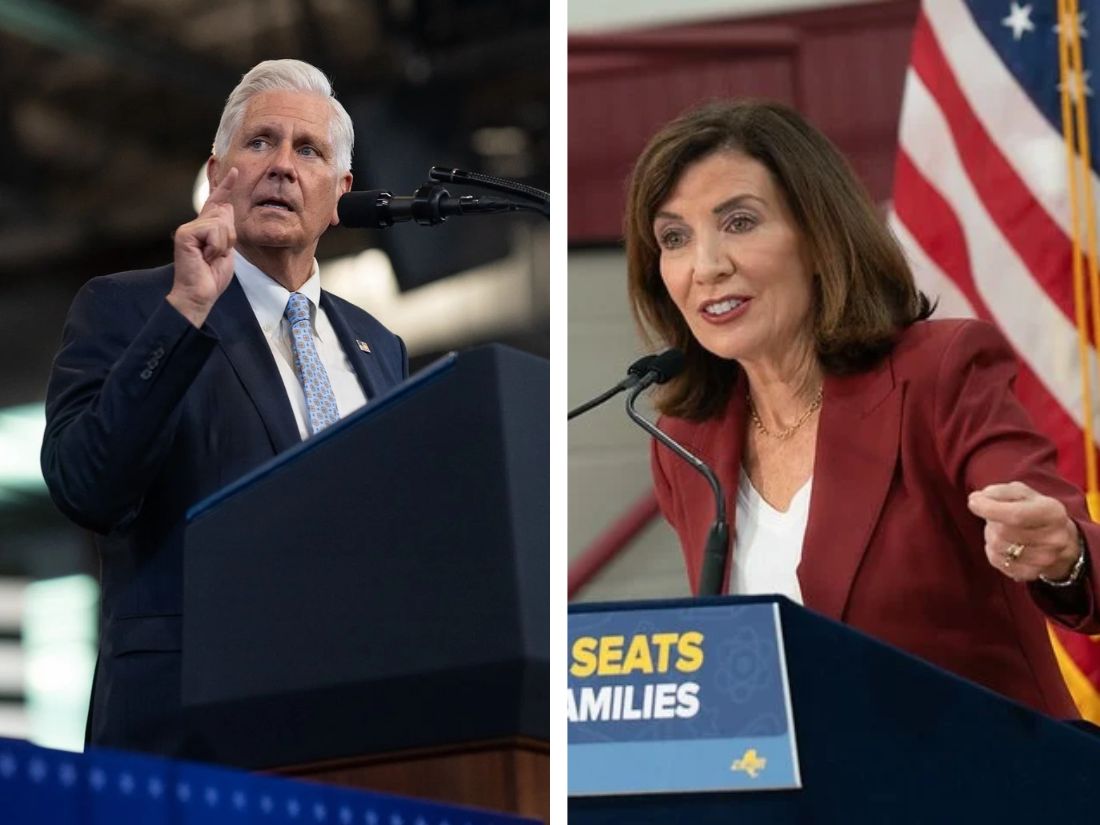
The two candidates running for New York governor in next month’s general election don’t have much in common, with diverging positions on immigration enforcement, data centers, Donald Trump and other issues.
But the contenders—Democrat Kathy Hochul, who is seeking reelection, and Republican and Nassau County Executive Bruce Blakeman—have at least one thing in common: their campaign websites are published in English only, with neither offering information in Spanish or other languages.
In New York, Latinos account for 2.2 million eligible voters, making them the largest ethnic and racial group after white voters, according to the Pew Research Center.
While not everyone who identifies as Hispanic or Latino speaks Spanish, a lot of them do.
In New York City alone, nearly half of residents—47 percent—speak a language other than English, according to the Department of City Planning, with Spanish the most common language among those with limited English proficiency.
“When a campaign communicates only in English, it can create a real information gap for voters who are more comfortable receiving political information in Spanish,” said Eddie Cuesta, executive director at Dominicanos USA, an organization that works to engage Dominican-Americans around civic participation.
“For many Latino voters, especially first-generation immigrants and older voters, Spanish is still the language they use most comfortably when discussing important issues,” Cuesta added.
“If the information is not available in Spanish, they may have to depend on family members, community organizations, Spanish-language media, or social media to understand a candidate’s platform.”
When asked, neither campaign offered an explanation for the lack of Spanish-language materials.
Blakeman’s team did not respond to City Limits’ questions. Last month, his campaign launched an initiative called “Latinos for Blakeman,” on its website and social media pages, asking potential Latino supporters to sign up to volunteer by knocking on doors or working the phones.
He also opened a campaign office in the Bronx earlier this week, just south of Yankee Stadium, “that’s focused specifically on reaching our Hispanic community,” according to a video posted on Blakeman’s social media accounts.
“We are running for governor for your children and your grandchildren so they can have a better life,” Blakeman says in the English-language video, where he was flanked by supporters holding campaign signs, also in English.

Experts from organizations focused on election law and language access policy called the lack of outreach a missed opportunity to engage Spanish-speaking New Yorkers. While local law requires voting materials—including ballots and registration forms—to be available in languages other than English, those rules don’t apply to candidates’ campaigns.
“It can create an information barrier even when it does not violate an election law,” said Isabelle Muhlbauer, national advocacy manager for voting rights at Latino Justice PRLDEF, which advocates for non-partisan voter protection initiatives and has deployed bilingual poll monitors and legal teams in various states.
“The voting rights issue is that there are Spanish-speaking voters for whom access to political information in Spanish can be important to their ability to participate fully in the electoral process,” Muhlbauer added.
Gov. Hochul herself enacted New York State’s expanded language access policy in 2022, requiring all state agencies that interact with the public to provide interpretation services and translation into the top 12 most commonly spoken non-English languages. Based on this premise, Hochul fairly consistently publishes policies and announcements from the governor’s office in Spanish.
However, such language law protections are conspicuously absent when it comes to the information provided by political campaigns. There aren’t any rules dictating non-English speakers have a certain level of access to political information.
“The extent to which candidates and campaigns do not provide Spanish-language materials for Latino voters is part of a larger issue, which is that these candidates and campaigns and political parties are generally not reaching out to Latino voters and working to engage them and to ask them to vote,” said Rosalind Gold, chief policy officer for NALEO Educational Fund, an organization working to facilitate Latino participation in elections and politics.
“We think that some candidates and campaigns take Latino voters for granted. Others think that, again, because they aren’t going to be the swing voters, they ignore them. So when candidates and campaigns really only focus resources on battleground states or battleground jurisdictions, Latinos don’t hear from them,” Gold added.
While its website offers information in English only, Hochul’s re-election campaign told City Limits they’ve made other efforts to reach Latino voters, including hiring a Latino Constituency Manager.
City Limits found a copy of the job description for the downstate region (New York City, Long Island, and Hudson Valley), which didn’t publicly mention the need to know Spanish or conduct work in that language. A campaign aide didn’t answer City Limits’ questions about the listing.
Hochul’s campaign instead said it has hired native Spanish-speaking organizers and has been distributing Spanish-language literature at Latino-centered events, like the Dominican Republic & Puerto Rico Day parades, community markets, and street fairs.
Hochul’s team told City Limits they’ve also set up a Latino advisory council with leaders from different parts of the state, and reached out directly to Latino business owners and visited commercial corridors in predominantly Latino communities across New York.
Camille Rivera, a Democratic strategist who was part of Zohran Mamdani’s mayoral campaign team—which became known for its multilingual social media content—said it’s not unusual for Latino voters to get overlooked.
“We keep making the same mistake every single time and winning on these margins,” Rivera said. “We have to be thoughtful around our campaigns, be excited to talk to new voters, and Latinos are a very important part of this country and a part of the state, and we have to do better in engaging them.”
She declined to comment specifically on the gubernatorial candidates’ campaign strategies.
“But I would say that this year I haven’t seen a lot of Latino engagement from the Democratic Party,” Rivera said.
Money talks (but not in Spanish)
City Limits asked the candidates how much they had spent or were planning to spend on campaign ads and other materials targeting Spanish-speaking voters, but neither answered this question directly.
Hochul’s campaign said they planned to spend more than $1 million on “Latino outreach programs,” including ads, mail, and digital media. (Hochul’s campaign for governor four years ago, when she was running against Long Island Republican Lee Zeldin, did include Spanish-language television ads by this time in the general election cycle.)
In mid-September, U.S. Rep. Alexandria Ocasio-Cortez, the Democrat from the Bronx, donated $300,000 to help boost the Democratic ticket in New York State, led by Hochul, with half of the money earmarked for Spanish-language outreach.
The State GOP did not immediately respond to City Limits’ queries about its own engagement efforts.
The state Board of Elections also couldn’t provide specific details on Spanish-language campaign spending. The office said that, “while their required campaign finance disclosure reports … disclose all expenditures for various purposes, there is no required designation on the report of whether the expenses were for materials in English, Spanish, etc.,” a spokesperson said via email.
But according to the ad-tracking firm AdImpact, an advertising intelligence and tracking company, only time on English-language broadcast and radio stations have been bought for the New York gubernatorial race, as of the end of September—a little over a month until the Nov. 3 election.
Both Hochul’s and Blakeman’s campaigns and supporters have targeted most of their broadcast spending so far to major networks such as ABC, CBS, and NBC, according to data that AdImpact shared with City Limits.
“Why aren’t we trying to build that [Latino] base?” said Rivera, the Democratic strategist. “It’s always quite clear that Latinos and communities of color, when it comes to long-term cultivation and engagement, are always a second priority.”
To reach the reporter behind this story, contact [email protected]. To reach the editor, contact [email protected]
Want to republish this story? Find City Limits’ reprint policy here.